



Translating a WordPress Website: Crawlable Locales and SEO
Translate WordPress into crawlable language URLs with sound plugin or multisite choices, hreflang, sitemaps, and an editorial workflow that keeps locales maintainable.
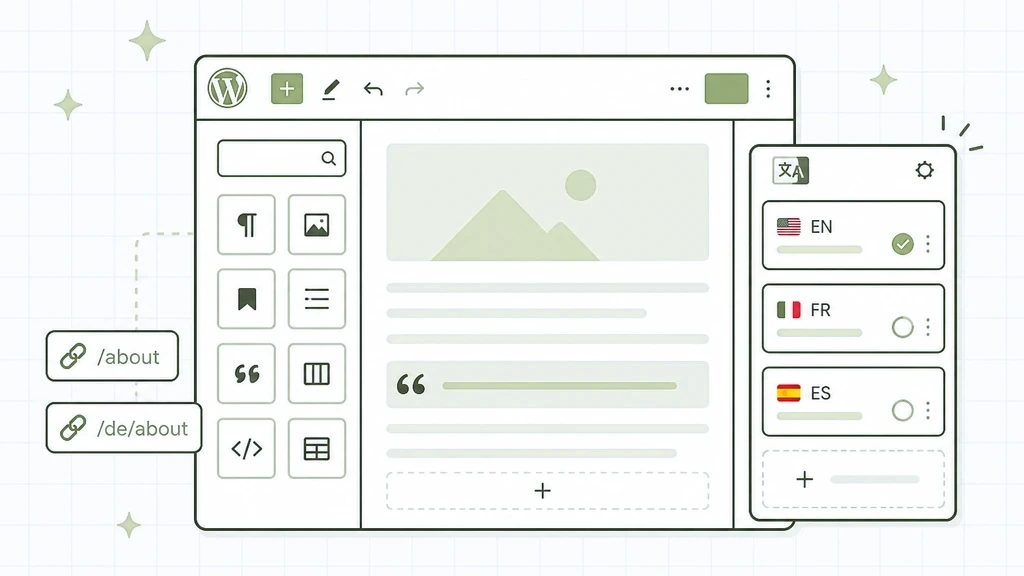
Translating a WordPress website means more than installing a multilingual plugin. Google expects each language version at its own crawlable URL, with navigation and body copy predominantly in one language, plus reciprocal hreflang when you publish alternates.
Quick answer: distinct WordPress URLs per language
WordPress sites scale through plugins, multisite networks, or external proxies—but SEO foundations stay constant: one crawlable URL per language. Google recommends different URLs for each language or region instead of cookies or browser language alone. Plugins that only swap text on /pricing via JavaScript or cookies leave search engines with a single indexed URL.
Start by rejecting single-URL language toggles. Then pick folder, subdomain, or domain patterns your team can maintain. Read international SEO versus multilingual SEO if you are deciding market scope before URL design.
WordPress multilingual architecture options
Three common architectures:
- Multilingual plugin on one site — adds locale prefixes or parallel slugs (
/en/about,/fr/a-propos). Lowest friction for small marketing sites. - WordPress multisite — separate sites per language under a network. Strong isolation; more ops overhead.
- Reverse proxy or headless layer — WordPress remains source; edge or static layer serves locale URLs. Good for performance-heavy stacks.
All three can satisfy Google when each locale has a distinct public URL and complete HTML. None justify cookie-only switches on one address.
URL patterns: folders, subdomains and domains
Folders (/de/, /es/) keep one certificate and one Search Console property (with locale reporting via paths). Subdomains (de.example.com) suit regional teams or CDN rules. ccTLDs signal country targeting when you operate truly local properties.
Google determines page language from visible content. Pick a pattern, document it, and keep permalinks stable after launch. Changing slug schemes breaks hreflang clusters and inbound links.
Avoid automatic redirects based on guessed language or location. Provide a visible language switcher linking to the alternate URL instead.
Plugin vs multisite vs proxy tradeoffs
Plugins (WPML, Polylang, TranslatePress, and others) differ in editor UX and URL models—evaluate crawlability, not marketing claims. Confirm the plugin creates separate URLs per language, not AJAX swaps on one permalink.
Multisite gives each locale its own theme options, menus, and users. Crawlability is natural because sites have distinct home URLs. Cost: network administration and plugin licensing per site.
Proxy approaches can serve cached locale HTML fast but must still emit correct canonicals and hreflang at the edge. WordPress language versions need distinct public URLs; cookie/JS-only swaps conflict with Google guidance.
When comparing tools, ask: Does each translation get a unique URL? Are hreflang and sitemaps automated or exportable? Can editors review in context?
Hreflang, canonicals and XML sitemaps
Implement hreflang in WordPress via SEO plugins, dedicated hreflang extensions, or sitemap xhtml:link entries. Hreflang must be reciprocal: if /en/about references /fr/a-propos, the French page must reference English and itself with matching codes.
Set canonical tags per language to the preferred URL for that locale. Do not point French pages to English URLs as canonical.
WordPress XML sitemaps should list each language URL and stay aligned with hreflang and canonical strategy. Many SEO plugins generate locale sitemaps; verify they include all translated custom post types, not only posts and pages. See our multilingual SEO platform overview for audit patterns.
Menus, widgets, media and theme strings
Themes often hard-code English in footers, buttons, and widget titles. Export theme strings through your plugin’s string translation UI or child theme overrides. Menus should be language-specific: French navigation should link to French URLs, not English slugs with translated labels.
Media needs alt text and captions per locale. Shared images are fine; metadata must match the page language. Widgets (search, newsletter, related posts) should pull localized content queries.
Keeping each URL predominantly in one language includes these chrome elements—not only post bodies.
Editorial workflow on WordPress
Maintainability breaks when translators work only inside post editors without glossary or TM. Layer:
- Glossary for product and legal terms
- Translation memory to reuse approved phrases
- Review states before publish
- Change detection when English updates
Google helpful-content guidance prioritizes people-first pages; thin or boilerplate-only translations fail that bar. Schedule periodic audits of top landing pages in each locale.
Implementation checklist
Bing Webmaster Guidelines also emphasize crawlable structure and useful content for indexing across markets.
Common mistakes
Single-URL AJAX translation — one indexed URL, invisible alternates.
Hreflang pointing to 404s or redirects — breaks reciprocity.
Mixed-language menus — French labels linking to English slugs.
Untranslated theme footer — dilutes language signals.
English canonical on translated posts — wrong consolidation.
Auto-redirect by country — blocks crawlers and users.
Machine translation without review on cornerstone content — thin locale pages.
Traditional search and answer-engine foundations
Shared foundations for WordPress multilingual plugins and public locale URLs still matter across Google, Bing, and answer engines: crawlable language versions, clear entities, evidence-backed claims, structured data where truthful, and real localization—not English-only shells. Treat the guides below as platform-specific lenses on the same multilingual delivery bar.
Platform guide: Google Search
For Google Search, discovery depends on crawlable locale URLs with language-appropriate HTML, accurate titles/headings, and reciprocal hreflang when alternates exist. Technical foundations include indexable content (not cookie-only switches), localized metadata, sitemaps, and canonical discipline. Content quality means people-first main content in each language; authority comes from clear organization identity and corroborating sources—not translation-tool marketing. Multilingual implication: each market or language URL must stand alone. Measure with Search Console coverage and URL Inspection per locale. Known vs uncertain: Google documents multilingual and hreflang behavior; it does not guarantee rankings from any CMS or MTPE workflow.
Platform guide: Bing
Bing discovers and indexes crawlable multilingual pages with clear structure, similar to Google’s URL and content clarity expectations. Technical foundations include fetchable locale URLs, useful content, and Bing Webmaster Tools monitoring. Prefer localized headings, claims, and FAQs over chrome-only translation. Authority signals still depend on trustworthy sources and consistent entities. Multilingual implication: do not hide languages behind client-only toggles. Measure indexation and crawl stats in Bing Webmaster Tools. Known vs uncertain: Bing guidelines emphasize crawlable useful content; do not invent Bing-only ranking factors for translation tooling.
Platform guide: ChatGPT
ChatGPT may cite or summarize publicly accessible pages when language versions are clear and answer-ready. Discovery is not a conventional crawl ranking; visibility looks like being selected as a source or referenced in answers. Technical foundations still start with accessible HTML URLs—not widget overlays that hide copy. Content qualities that help include direct answers, FAQs, and stable terminology from glossaries. Authority comes from evidence and consistent entities across locales. Multilingual implication: each locale page should be readable on its own. Measurement is imperfect—treat citation checks as hypotheses. Known vs uncertain: there is no documented guarantee that MTPE or any CMS integration produces ChatGPT citations.
Platform guide: Gemini
Gemini and related Google AI experiences benefit from coherent entities, structured data where accurate, and indexable localized pages. Visibility is about being referenced or recognized—not inventing Gemini ranking factors. Technical foundations overlap Google Search crawlability and metadata quality. Content should present clear claims and definitions per language. Authority depends on organization consistency and corroboration. Multilingual implication: glossary-controlled product names reduce cross-locale confusion. Measure traditionally via Search Console and qualitatively sample AI answers. Known vs uncertain: Gemini behavior is not a substitute for documented Google Search guidance on hreflang and language versions.
Platform guide: Google AI Overviews
Google AI Overviews may link supporting pages; eligibility framing still rests on people-first, indexable content. They are not a language switch and do not replace hreflang. Technical foundations remain crawlable locale HTML and truthful structured data. Content qualities include concise answers and clear headings in each language. Authority signals mirror helpful-content expectations. Multilingual implication: Overview inclusion is not guaranteed for any translated page. Measure Search Console generative reports where available and keep traditional index metrics separate. Known vs uncertain: no translation workflow can promise Overview placement.
Where GlotEO fits
WordPress teams often outgrow ad hoc plugin workflows when glossary control and SEO validation matter. GlotEO offers a WordPress translation integration so marketers manage locales while WordPress keeps crawlable URLs. Review GlotEO pricing and plans and the website localization platform when comparing rollout options.
Citations
- Supports guidance cited in this article (Bing Webmaster Guidelines)
- Supports guidance cited in this article (How to specify a canonical URL with rel=canonical and other methods)
- Supports guidance cited in this article (Creating helpful, reliable, people-first content)
- Supports guidance cited in this article (Tell Google about localized versions of your page)
- Supports guidance cited in this article (Managing multi-regional and multilingual sites)
- Supports guidance cited in this article (Learn about sitemaps)