



International SEO vs Multilingual SEO: What's the Difference?
Learn how multilingual SEO and multi-regional (international) SEO differ, when you need both, and how URL structure, hreflang and canonicals follow from that distinction.
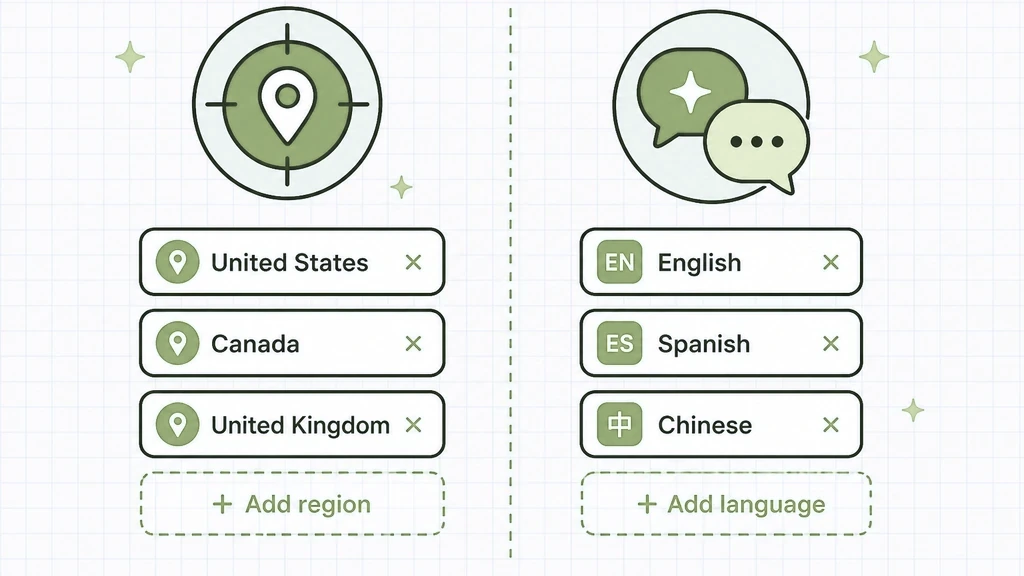
Teams planning international growth often ask whether they need multilingual SEO, international SEO, or both. The short answer is that those labels overlap in marketing conversation, but Google’s documentation separates two clearer ideas: multilingual sites (more than one language) and multi-regional sites (explicit country targeting). International SEO, in practice, is the umbrella work of making a site discoverable across countries and languages. Multilingual SEO is the language half of that problem. Multi-regional SEO is the country half.
This guide compares those ideas side by side, shows when you need one or both, and turns the distinction into URL, hreflang and canonical decisions you can implement without unsupported ranking claims.
Questions this guide answers
- What is the difference between multilingual SEO and multi-regional (international) SEO?
- When does a site need both multilingual and multi-regional strategies at once?
- How should URL structure choices differ when targeting languages versus countries?
- What signals do search engines use to understand language versus target country?
- How do hreflang annotations support both language and regional variants?
- How should teams handle similar same-language pages across countries?
- Which common mistakes happen when teams confuse multilingual and international SEO?
Quick answer: multilingual vs multi-regional SEO
Multilingual SEO focuses on helping search engines and users find the right language version of your content. Google defines a multilingual website as one that offers content in more than one language—for example a Canadian business with English and French versions. Google Search tries to match pages to the searcher’s language.
Multi-regional SEO (the country-targeting part of international SEO) focuses on helping search engines and users find the right country or locale experience. Google defines a multi-regional website as one that explicitly targets users in different countries—for example shipping to both Canada and the United States. Google Search tries to find the right locale page for the searcher.
You can need one, the other, or both. Google explicitly notes that some sites are both multi-regional and multilingual at once.
Why the industry mixes the terms
Marketers often say “international SEO” when they mean any of the following:
- translating a site into new languages
- launching country stores with local currency and fulfillment
- combining both language and country experiences
- implementing hreflang for language or region codes
That loose usage is fine for planning conversations, but it becomes expensive when engineering treats every international project as “just translate the pages,” or when localization teams treat every country launch as “just add a ccTLD.”
Use Google’s vocabulary when you specify requirements:
| If your goal is… | Specify… |
|---|---|
| Serve content in more languages | Multilingual SEO / language versions |
| Serve country-specific experiences | Multi-regional SEO / geotargeting |
| Do both | Combined multilingual + multi-regional architecture |
Side-by-side comparison
| Dimension | Multilingual SEO | Multi-regional SEO |
|---|---|---|
| Primary question | Which language should this user get? | Which country/market experience should this user get? |
| Google’s definition focus | Content in more than one language | Explicit targeting of users in different countries |
| Typical example | English + French site for one market | Separate US and Canada experiences |
| Language detection | Driven by visible page content, not lang or hreflang | Language still matters, but country signals also apply |
| Common URL patterns | /en/, /fr/ or language subdomains | ccTLDs, country subdomains, or /us/, /ca/ directories |
| Annotation pattern | hreflang="en", hreflang="fr" | hreflang="en-US", hreflang="en-CA" (and/or country URL strategy) |
| Main failure mode | Cookie-based language switching; boilerplate-only translation | Duplicate same-language country URLs without clear canonical preference |
When you need both at once
Google’s own combined example is useful: a site with different versions for the USA and for Canada, and both French and English versions of the Canadian content. That is multi-regional (US vs Canada) and multilingual (EN vs FR in Canada).
You likely need both when:
- you sell into multiple countries and those countries are not monolingual
- the same country needs more than one language (Belgium, Canada, Switzerland)
- regional English or Spanish variants differ enough to deserve separate URLs (
en-USvsen-GB), while other languages remain global
You may only need multilingual SEO when:
- one primary market needs multiple languages
- country fulfillment, pricing and legal terms stay the same
You may only need multi-regional SEO when:
- content stays in one language
- markets differ by currency, shipping, regulation or catalog even when language is shared
A useful workshop prompt: for each market, write one sentence that starts with “Users in this market need…” If the sentence is about language comprehension, you are in multilingual territory. If it is about shipping, tax, catalog or legal presence, you are in multi-regional territory. If both appear, design for both before you buy translation volume.
Also separate content ownership. Language versions usually need localization specialists. Country versions often need market operators who own pricing and offers. When one team owns both without a matrix, hreflang and IA decisions tend to lag launches.
How search engines read language vs country
Language
Google determines page language from visible content. It does not use HTML lang attributes, the URL, or hreflang to detect language. Hreflang declares relationships between alternate versions; it does not set the language of the page.
Practical implications:
- keep each page predominantly in one language for content and navigation
- avoid side-by-side dual-language pages that confuse detection
- treat translation quality as an SEO input, not only a UX nicety
Country / locale
Google uses multiple signals for target locale, including:
- country-code top-level domains (ccTLDs)
- hreflang statements
- server location (imperfect, especially with CDNs)
- on-page cues such as local addresses, phone numbers, currency and local language
Google ignores locational meta tags such as geo.position for geotargeting. Geotargeting is not an exact science, so provide user-facing links to choose region or language when someone lands on the wrong version.
Google also notes that targeting a specific country can improve results in that country at the expense of other locales or languages—a trade-off, not a guarantee for any single site.
URL architecture decisions
Google recommends different URLs for each language version, rather than changing language with cookies or browser settings on a single URL. Dynamic switching can hide variants from crawlers because Googlebot often crawls without Accept-Language and commonly from US infrastructure.
For geotargeting, Google documents these locale-specific URL options:
| Structure | Example | Fit |
|---|---|---|
| Country-code domain | example.de | Strong country signal; higher cost and constraints |
| Subdomain on a gTLD | de.example.com | Flexible separation; codes can be ambiguous to users |
| Subdirectory on a gTLD | example.com/de/ | Often easiest to maintain on one host |
| URL parameters | example.com?loc=de | Not recommended for geotargeting segmentation |
Decision tip: choose the structure your team can maintain for years. Multilingual folders on one host are often enough for language expansion. Country ccTLDs make more sense when legal, brand or hosting realities require hard market separation. Many combined programs use subdirectories like /en-us/, /en-ca/, /fr-ca/ on a single domain when operations prefer one CMS.
If you already have a global English site and are adding Germany, do not assume /de/ automatically means “German language for Germany.” It might mean German language worldwide, Germany in English, or German for Germany. Name the intent in the matrix first, then encode it in the path and hreflang values. Ambiguous folder codes are a frequent source of later rework.
Hreflang for language and region variants
Hreflang tells Google about language or region variants so Search can point users to the most appropriate version. Google supports HTML link tags, HTTP headers, or sitemaps; the methods are equivalent from Google’s perspective.
Key rules:
- each version should list itself and the other versions
- URLs must be fully qualified
- annotations should be reciprocal; otherwise they may be ignored
- use language codes alone (
fr) or language-plus-region (fr-CA) - use
x-defaultfor unmatched languages, especially on selectors
Hreflang supports both sides of this comparison:
- multilingual pairs:
en↔de - multi-regional same-language pairs:
en-US↔en-GB - combined clusters:
en-US,en-CA,fr-CA, plusx-default
Language-specific labels in a subdomain or folder are not enough by themselves. Google notes that subdomain codes are not used to determine target audience unless you map audience explicitly (for example with hreflang).
Same-language multi-country pages and canonicals
Multi-regional sites often publish similar content in the same language on different URLs—for example German content on both example.de/ and example.com/de/. Google advises picking a preferred version and using rel="canonical" together with hreflang so the correct language or regional URL can be served.
When using hreflang, specify a canonical in the same language, or the best available substitute language if a same-language canonical does not exist.
Localized versions are only considered duplicates when the main content remains untranslated. Small regional variations in one language are a legitimate alternate-page scenario; wholesale duplication without a preferred URL is not.
Decision framework: which strategy do you need?
Use this sequence in planning workshops:
- List markets you will sell into (countries).
- List languages each market needs.
- If languages > 1 and countries = 1 → prioritize multilingual SEO.
- If countries > 1 and languages = 1 → prioritize multi-regional SEO.
- If both > 1 → design a combined matrix of country × language URLs.
- For each URL, decide whether differences are language-only, country-only, or both.
- Choose a maintainable URL pattern before commissioning translation.
- Plan hreflang clusters and canonical rules before launch, not after indexing problems appear.
- Provide manual language/region switchers; avoid forced redirects based on guessed locale.
- Document the matrix in your content brief so engineering, localization and SEO share one source of truth.
Common planning mistakes
Which common mistakes happen when teams confuse multilingual and international SEO?
- Treating translation as geotargeting (or the reverse)
- Using one URL with cookie-based language switching
- Auto-redirecting users away from alternate versions based on IP or browser language
- Assuming URL path codes or
langattributes detect language for Google - Launching same-language country duplicates without canonical preference
- Building incomplete hreflang clusters without return links
- Using URL parameters as the primary international architecture
- Promising ranking lifts from geotargeting without acknowledging trade-offs and uncertainty
- Translating only navigation chrome while leaving main content untranslated
- Starting design systems before the country × language matrix is agreed
Implementation checklist
Where GlotEO fits
Once the strategy is clear, the hard part is keeping research, briefs and language versions aligned while engineering ships URL and annotation foundations. GlotEO’s SEO-optimized multilingual websites can support that editorial workflow for multilingual and international programs—without replacing the architectural decisions above.
If you are comparing language expansion with country expansion, start with the matrix, then use a disciplined content process to execute it.
Explore GlotEO’s SEO-optimized multilingual websites or compare GlotEO plans.
For a deeper technical walkthrough of multilingual implementation, a companion multilingual SEO guide is already drafted for the library. Dedicated hreflang and international architecture guides remain on the roadmap as planned articles.