



How to Translate a Webflow Website for Multilingual SEO
Plan Webflow locale URLs, localized SEO fields, CMS alignment, hreflang, and QA workflows so each language version is crawlable and people-first.
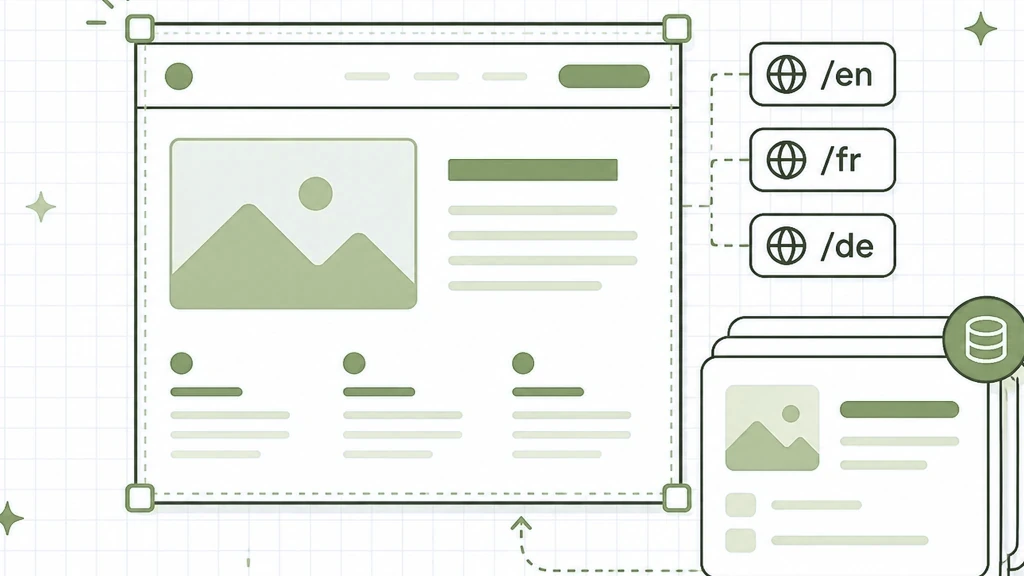
Translating a Webflow site is not only a design or CMS task—it is an international SEO architecture decision. Webflow teams often start with a language switcher widget or a third-party overlay, then discover that Google cannot reliably crawl distinct language versions, metadata stays in English, or hreflang clusters break when CMS collections drift.
This guide walks Webflow marketers and freelancers through a crawlable locale plan grounded in Google’s multilingual documentation: distinct URLs per language, localized SEO fields, CMS alignment, hreflang and sitemaps, native versus third-party translation approaches, and a review workflow that prevents mixed-language pages. No ranking guarantees—only practices Google and Bing document for discoverable language versions.
Quick answer: localize Webflow pages on distinct URLs
Short answer: Publish each Webflow language version on its own crawlable URL with localized primary content, navigation, and metadata—not on cookie-only or browser-language switches alone.
Google recommends different URLs for each language or region version rather than relying on cookies or browser settings alone. For Webflow, that usually means subdirectories such as /fr/ or /de-de/, locale-specific CMS items, and a visible language selector that links to those URLs. Pre-rendered pages in Webflow’s publish pipeline help crawlers see the same HTML users see.
Avoid auto-redirecting visitors based on guessed language or location. Google advises against automatic redirects and recommends a user-visible language or country selector instead. Let users choose; let crawlers follow links.
Webflow URL and locale planning
Before you translate a single string, decide how locales map to URLs. Common Webflow patterns:
- Subdirectory locales (
example.com/fr/about) on one site—often the simplest for freelancers and marketing teams. - Subdomain locales (
fr.example.com) when legal or analytics separation matters. - Separate Webflow sites per major market when design systems diverge significantly.
Whatever pattern you choose, each language version needs a stable, linkable URL that appears in navigation and sitemaps. Google determines page language primarily from visible content; keep each URL predominantly in one language for both body copy and navigation.
Document a locale matrix early: source page → locale URL → CMS item ID → hreflang code. When you add French, you should know exactly which English pages have French alternates and which are intentionally single-language.
Pair URL planning with international SEO versus multilingual SEO strategy so language and country targeting stay aligned with business goals.
SEO title, meta and Open Graph per locale
Webflow exposes page-level SEO settings: title tag, meta description, Open Graph title and description, and often Twitter cards. Localize all of these per locale URL, not just the visible H1.
Localized SEO titles and meta descriptions should be unique per locale URL rather than shared English metadata across languages. A French product page with an English <title> sends mixed signals to Google and weakens click-through in French SERPs.
Checklist for each localized Webflow page:
- Title tag — written for local query intent, not word-for-word English paste.
- Meta description — unique, human-readable summary in the target language.
- Open Graph / social — localized preview text and images where markets differ.
- Slug — consider localized slugs when they help users; keep redirects if you change them later.
- Canonical — each locale URL should canonical to itself unless you deliberately consolidate duplicates.
Google helpful-content guidance prioritizes people-first pages; thin or boilerplate-only language versions are weak SEO and weak answer sources. Metadata localization is necessary but not sufficient—you still need substantive body content.
CMS collections and shared design systems
Webflow CMS powers blogs, case studies, team pages, and product catalogs. Multilingual CMS work fails when collections fall out of sync: three French posts link to English case studies, or a shared reference field points at the wrong locale item.
Practical alignment strategies:
- Mirror collection structure per locale (separate items per language) with a shared internal ID or reference field linking equivalents.
- Field-level localization when Webflow localization features or integrations support locale-specific fields on one item.
- Shared components, localized content — keep design system classes consistent; swap text, images, and links per locale.
When a CMS template renders mixed languages—English author bio on a German article—Google sees a page that does not match user expectations. Audit collection templates for chrome strings, empty states, and filter labels.
Hreflang, canonicals and sitemaps
Hreflang annotations tell Google about alternate language or regional URLs and must be reciprocal across the set of pages they describe. On Webflow, implement hreflang via:
- Custom code in site or page
<head>(often generated from your locale matrix), - HTTP headers at the hosting edge if your stack supports it, or
- XML sitemaps with
xhtml:linkalternates.
XML sitemaps help discovery of language versions and can carry xhtml:link hreflang annotations when used as an implementation method. Submit updated sitemaps after locale launches.
Each language or locale URL should have a clear canonical that prefers the same-language preferred URL when duplicates exist. Do not point every locale’s canonical at the English homepage while also publishing fully localized pages—you will confuse consolidation signals.
Pick one primary hreflang method and regenerate the full reciprocal set whenever you add or remove a locale. Manual one-off tags on a handful of pages break clusters quickly.
For deeper hreflang mechanics, see your multilingual SEO product capabilities alongside Google’s localized-versions documentation.
Native vs third-party translation approaches
Webflow teams typically choose among:
Native Webflow localization (when available on your plan) — locale fields, localized publishing, and URLs inside the Webflow ecosystem. Pros: stays close to designer workflows. Cons: still requires editorial QA and SEO field discipline.
Third-party translation overlays — JavaScript layers that swap text client-side. Pros: fast-looking launches. Cons: often weaker for crawlability if distinct URLs and server-rendered HTML are missing—Google recommends crawlable URLs, not cookie-only delivery.
Export / TMS / re-import workflows — translate in a CAT tool or platform, then publish localized CMS items. Pros: scales with glossaries and translation memory. Cons: needs process to prevent stale English fallbacks.
There is no universal winner. Evaluate based on whether each approach produces distinct crawlable URLs, localized metadata, and maintainable hreflang—not on demo speed alone.
Editorial workflow and QA
Mixed-language pages usually come from process gaps, not platform bugs. A practical Webflow QA workflow:
- Locale completeness gate — no publish if required fields are empty in the target locale.
- Language spot check — navigation, buttons, form labels, and error messages match the page language.
- Link audit — internal links stay inside the same locale unless intentionally cross-language.
- SEO field review — title, meta, OG localized.
- Hreflang reciprocity sample — test five URL pairs after each locale batch.
- Staging crawl — fetch rendered HTML; confirm language and annotations.
Assign an owner for the locale matrix. Designers should not be the only people who know which pages exist in German.
Implementation checklist
Use this launch list for each new Webflow locale:
Common mistakes
These Webflow translation mistakes hurt SEO most often:
- Cookie or browser-language only — no crawlable alternate URLs.
- English metadata on localized pages — titles and descriptions never translated.
- Boilerplate-only translation — nav in French, body still English.
- Broken hreflang reciprocity — new locale added on some templates only.
- Auto-redirect by IP — blocks users and crawlers from alternates.
- CMS reference drift — localized posts linking to English assets.
- Thin locale stubs — placeholder pages published to “claim” a market.
- Duplicate overlays plus native locales — two systems fighting for the same URLs.
Bing Webmaster Guidelines also emphasize crawlable, useful content and clear site structure for indexing across markets—many of the same crawlability rules apply outside Google.
Traditional search and answer-engine foundations
Shared foundations for Webflow locale pages with localized SEO fields still matter across Google, Bing, and answer engines: crawlable language versions, clear entities, evidence-backed claims, structured data where truthful, and real localization—not English-only shells. Treat the guides below as platform-specific lenses on the same multilingual delivery bar.
Platform guide: Google Search
For Google Search, discovery depends on crawlable locale URLs with language-appropriate HTML, accurate titles/headings, and reciprocal hreflang when alternates exist. Technical foundations include indexable content (not cookie-only switches), localized metadata, sitemaps, and canonical discipline. Content quality means people-first main content in each language; authority comes from clear organization identity and corroborating sources—not translation-tool marketing. Multilingual implication: each market or language URL must stand alone. Measure with Search Console coverage and URL Inspection per locale. Known vs uncertain: Google documents multilingual and hreflang behavior; it does not guarantee rankings from any CMS or MTPE workflow.
Platform guide: Bing
Bing discovers and indexes crawlable multilingual pages with clear structure, similar to Google’s URL and content clarity expectations. Technical foundations include fetchable locale URLs, useful content, and Bing Webmaster Tools monitoring. Prefer localized headings, claims, and FAQs over chrome-only translation. Authority signals still depend on trustworthy sources and consistent entities. Multilingual implication: do not hide languages behind client-only toggles. Measure indexation and crawl stats in Bing Webmaster Tools. Known vs uncertain: Bing guidelines emphasize crawlable useful content; do not invent Bing-only ranking factors for translation tooling.
Platform guide: ChatGPT
ChatGPT may cite or summarize publicly accessible pages when language versions are clear and answer-ready. Discovery is not a conventional crawl ranking; visibility looks like being selected as a source or referenced in answers. Technical foundations still start with accessible HTML URLs—not widget overlays that hide copy. Content qualities that help include direct answers, FAQs, and stable terminology from glossaries. Authority comes from evidence and consistent entities across locales. Multilingual implication: each locale page should be readable on its own. Measurement is imperfect—treat citation checks as hypotheses. Known vs uncertain: there is no documented guarantee that MTPE or any CMS integration produces ChatGPT citations.
Platform guide: Gemini
Gemini and related Google AI experiences benefit from coherent entities, structured data where accurate, and indexable localized pages. Visibility is about being referenced or recognized—not inventing Gemini ranking factors. Technical foundations overlap Google Search crawlability and metadata quality. Content should present clear claims and definitions per language. Authority depends on organization consistency and corroboration. Multilingual implication: glossary-controlled product names reduce cross-locale confusion. Measure traditionally via Search Console and qualitatively sample AI answers. Known vs uncertain: Gemini behavior is not a substitute for documented Google Search guidance on hreflang and language versions.
Platform guide: Google AI Overviews
Google AI Overviews may link supporting pages; eligibility framing still rests on people-first, indexable content. They are not a language switch and do not replace hreflang. Technical foundations remain crawlable locale HTML and truthful structured data. Content qualities include concise answers and clear headings in each language. Authority signals mirror helpful-content expectations. Multilingual implication: Overview inclusion is not guaranteed for any translated page. Measure Search Console generative reports where available and keep traditional index metrics separate. Known vs uncertain: no translation workflow can promise Overview placement.
Where GlotEO fits
Webflow localization succeeds when design, CMS, and SEO ops share one source of truth for locales. GlotEO Webflow translation integration helps teams manage website localization workflows—linking briefs, glossaries, and review steps—while you keep Webflow’s visual stack and crawlable URL architecture intact.
If you are scaling beyond a handful of manual page copies, explore the website localization platform to coordinate translation, QA, and publish gates without losing SEO signals. Review GlotEO pricing and plans when you are ready to compare workflow tiers.
Pair this implementation guide with international SEO versus multilingual SEO for strategy context, and use multilingual SEO tooling when hreflang and metadata governance become part of everyday editorial work.
Citations
- Supports guidance cited in this article (Bing Webmaster Guidelines)
- Supports guidance cited in this article (How to specify a canonical URL with rel=canonical and other methods)
- Supports guidance cited in this article (Creating helpful, reliable, people-first content)
- Supports guidance cited in this article (Tell Google about localized versions of your page)
- Supports guidance cited in this article (Managing multi-regional and multilingual sites)
- Supports guidance cited in this article (Learn about sitemaps)