



Translate Website to Chinese: Simplified Script, Layout & zh-Hans
Translate your website to Chinese with a Simplified vs Traditional fork, layout-safe UI, zh-Hans URLs, hreflang, and a launch checklist.
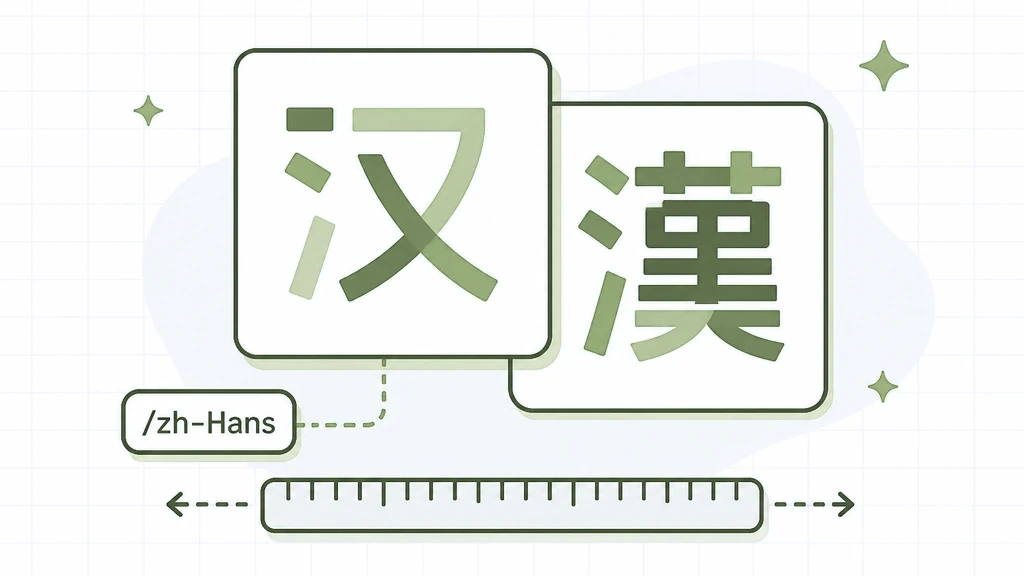
If your brief says “translate the website to Chinese,” stop. Chinese on the web is first a script decision: Simplified (zh-Hans, often shipped as zh-CN) versus Traditional (zh-Hant / zh-TW, zh-HK). Mixing them in one locale is how you lose trust in a single viewport.
This article focuses on Simplified Chinese launches—the usual first step for mainland-oriented product sites—while calling out the Traditional fork so you do not paint yourself into a corner.
What does it take to translate a website to Chinese (Simplified) beyond swapping strings?
Beyond CMS fields and a bilingual glossary, you need a locked Simplified vs Traditional policy, fonts that actually contain your glyphs, truncation rules that do not assume spaces between words, and a real Simplified Chinese URL whose body is actually Chinese.
Questions this guide answers
- What does it take to translate a website to Chinese (Simplified) beyond swapping strings?
- Which Chinese (Simplified) locale or regional variants should you choose?
- What script, typography, and layout issues are unique to Chinese (Simplified)?
- How should URLs, hreflang, and indexing work for a Chinese (Simplified) site version?
- What onboarding and checkout nuances matter in Chinese (Simplified)?
- Should you use AI translation, MTPE, or human review for Chinese (Simplified)?
- What SEO mistakes specifically hurt Chinese (Simplified) pages?
- How do you launch and measure a Chinese (Simplified) website version?
Quick answer: translate your website to Chinese (Simplified) the right way
A durable Simplified Chinese launch looks like this:
- Treat Simplified and Traditional as separate locales, not a font toggle.
- Start with
zh-Hans(oftenzh-CN) if mainland readers are the first audience; plan Traditional as its own project. - Publish Simplified Chinese on its own crawlable URL—not a cookie-only switch.
- Prototype primary screens with real Chinese copy so buttons, cards, and nav can survive density and missing word spaces.
- Research queries in Simplified Chinese characters, not by translating English head terms or publishing pinyin-only pages.
- Add reciprocal hreflang, sane canonicals, and sitemaps before you scale.
CSA Research’s survey of 8,709 consumers in 29 countries found 76% prefer buying with information in their own language and 40% will never buy from websites in other languages. That still holds when some Chinese speakers also read English: checkout, invoices, and support are where an English-only journey quietly loses the sale. Google’s helpful-content guidance favors people-first pages; a Chinese nav around English body copy is a weak locale for users and search. For market-versus-language strategy, read how international SEO differs from multilingual SEO.
Choose the right Chinese (Simplified) locale
Most teams begin with zh-Hans and a mainland-oriented zh-CN URL if that is the first commercial market. That is a reasonable first release. It is not a license to label the locale “Chinese” and later paste Traditional strings into the same file.
Traditional Chinese (zh-Hant) is a hard fork: Taiwan (zh-TW) and Hong Kong (zh-HK) differ in vocabulary, UI metaphors, and sometimes preferred register. You can still architect both locales on day one (separate message files, separate URLs) even if you only fill Simplified first. Do not reuse one translation memory as if the scripts were interchangeable.
Singapore and Malaysia include Simplified readers, but product copy, currency, and legal pages may still need a local pass if you sell there. A single zh-Hans file can be the right first ship if you are not localizing pricing and contracts yet—just do not pretend one glossary covers mainland, Singapore, Taiwan, and Hong Kong without a native review.
Decide register (formal written UI vs casual product voice) before translators open a file. Mainland B2B, fintech, and healthcare usually need formal written Chinese. Consumer apps sometimes want a warmer tone—but mixing textbook formality on the homepage with chatty checkout microcopy reads as unfinished. Put the choice in the glossary so every vendor and model uses the same posture.
Also decide how you will handle names, addresses, and phone numbers. Forms that only accept “first name / last name” in Western order, or that reject Chinese characters in address lines, fail after the strings look “translated.”
Chinese (Simplified) script, typography, and layout nuances
Simplified Chinese uses Han characters with no spaces between words. Truncation, CSS word-break, and line clamps behave differently than in English. A 12-character English budget is meaningless; a clamp that cuts mid-phrase can leave a fragment that looks like a different word.
Characters are denser than Latin text. Buttons that fit English often look sparse—or they overflow once the label is a four-character verb-object pair. Missing glyphs are an instant quality failure: fallback tofu boxes destroy trust faster than an awkward sentence.
Layout rules that prevent launch-week screenshots:
- Prototype key screens with real Simplified Chinese copy before you announce the locale.
- Prefer flexible containers over English character budgets.
- Allow buttons to wrap or grow; do not shrink type to keep a one-line English CTA.
- Ship production fonts with coverage for your actual character set (UI, email, and PDFs).
- Define a line-breaking policy (
line-break,word-break) with a reviewer who can see when a split is readable. - Watch card titles, badges, and table headers—these are where density plus clamps go wrong.
Dates and numbers are part of the layout contract. Mainland users typically expect year-month-day (2026-08-24 or 2026年8月24日), full-width punctuation in running text, and currency formatting that matches the market you claim to serve (CNY vs a Singapore dollar storefront). Sorting Chinese lists by Unicode code point is not “alphabetical order” in any useful sense; if you ship directories or filter chips, define collation before you call the locale done.
Cadence matters. English CTAs are often abrupt. Chinese marketing copy can be more complete without becoming bureaucratic—while payment and error copy stay plain. Train reviewers to protect payment clarity while giving homepage enough room to sound like Chinese, not translated English.
Formal written UI often differs from casual spoken Mandarin. Machine output can sound oddly textbook or oddly chatty. That is a review problem, not a font problem.
Crawlable URLs, hreflang, and indexing
Google recommends different crawlable URLs for each language or region version rather than cookies or browser language alone. Google determines page language primarily from visible content—so a translated nav around English body copy is a weak Chinese version. Give Simplified Chinese its own folder or host pattern (/zh/, /zh-cn/, or an explicit zh-Hans path strategy) and keep that pattern consistent across templates, analytics, and internal links.
Hreflang annotations must be reciprocal across the alternate set you declare. That matters the moment Traditional Chinese exists beside Simplified; a vague zh tag is how you send the wrong alternate. Each locale URL should carry a clear canonical that prefers the same-language preferred URL when duplicates exist. Do not canonical a Simplified page to its English equivalent.
Bing Webmaster Guidelines emphasize crawlable, useful content and clear site structure across markets. Build once for shared foundations, then monitor Google Search Console and Bing Webmaster Tools where you operate both. Google advises against automatically redirecting users based on assumed language or location; offer a visible selector that links to the Simplified URL instead. IP-guessing “China → /zh” traps travelers, VPNs, and crawlers.
Pinyin-only pages are not a substitute for Chinese content. If you need a Latin fallback for a brand token, keep it as a brand token—not as the page.
Onboarding, trust, and checkout in the target language
Simplified Chinese trust pages do more work than a translated feature list. Sites that sell to mainland buyers typically need privacy, terms, and (where relevant) payment and after-sales copy that read as real pages, not leftover English templates. That is not a ranking tactic; it is what users look for when they decide whether a checkout is legitimate. Treat those pages as first-class localization, and have a qualified reviewer own legal-adjacent wording—do not improvise them in a translation memory.
Practical Simplified Chinese conversion checks:
- Homepage, ads, and product UI use the same register (formal vs casual).
- Forms accept Chinese characters for names and addresses, or they explain why a Latin field is required.
- Cookie and consent strings are reviewed in the actual banner—these run long and wrap badly.
- Pricing, invoices, and currency language match the market you claim to serve.
- Support macros and transactional email match the product’s formality.
- Error messages name the fix rather than a polite empty apology.
- Comparison tables and feature matrices are human-reviewed; dense characters plus column headers are layout-hostile.
You do not need every blog post on day one. You do need homepage and product explanation, authentication, pricing, checkout/billing, privacy basics, support entry points, and the legal pages your market expects. Archive posts can follow via MTPE.
The myth that “Chinese buyers will just use English” is only half true. Some will browse docs in English. Enough will not complete checkout, billing, or support in English that you still leave money on the table—especially outside tech-early-adopter niches.
AI, MTPE, and human review for this language
Use risk to choose the workflow—not tool branding:
- Raw machine translation: fine for internal drafts only. Character choice, register drift, and UI density are easy for models to look “done” while sounding wrong.
- MTPE (machine translation + post-editing): a solid default for many product and support pages when glossary, register, and Simplified/Traditional gates exist.
- Human translation / brand editing: homepage, pricing, campaigns, cookie/consent, and any legal-adjacent page.
A practical review loop for Simplified Chinese:
- MTPE draft against the glossary (script and register locked).
- Brand editor pass on homepage, pricing, and key landing pages.
- Product linguist pass on errors, billing, and dynamic UI—especially clamps and buttons.
- Staging QA in Simplified Chinese at mobile widths—not only a side-by-side string review.
- Native pass for Traditional (
zh-TW/zh-HK) only when you actually serve those markets.
People-first helpful content expectations apply in every language. Low-quality machine-only Chinese pages can look complete in a CMS while still failing users and search quality bars.
Chinese (Simplified)-specific SEO pitfalls
Chinese searchers look for character-language queries. Translating English head terms word-by-word, or ranking a pinyin-only URL, misses how people actually search. Do Simplified Chinese keyword research, then write titles and H1s that sound like Chinese results pages—not like English metadata with nouns swapped.
Localize titles, meta descriptions, and headings per Simplified URL. Do not reuse one English metadata set across locales.
Mistakes that specifically hurt Simplified Chinese pages:
- Boilerplate-only translation — chrome Chinese, body still English.
- Script mixing — Simplified and Traditional in one locale file.
- Missing glyphs in production fonts, email, or PDFs.
- Cookie-only language switches that hide the Chinese URL from crawlers.
- Broken hreflang (missing return links, or a generic
zhthat collides with Traditional). - Automatic geo redirects that trap users and bots.
- Pinyin-only pages treated as a Chinese language version.
- Thin MT-only locales that fail helpful-content expectations.
Fix script, layout, and architecture before you scale to Traditional Chinese. Tooling should enforce the process—not invent ranking promises.
Launch checklist
Use this checklist when you are ready to ship Simplified Chinese:
Where GlotEO fits
Simplified Chinese is a strong fit for translation memory: product nouns and UI verbs recur, and they must not flip to Traditional by accident. Glossary and memory in the website localization platform keep script, register, and feature names stable while layout-tested copy ships. Pair that with multilingual SEO tooling so Chinese URLs, hreflang, and metadata stay reviewable as you expand. Compare GlotEO pricing and plans when you scope the first Simplified release, or start from a broader website translation workflow if you are still choosing languages.