



MTPE vs Human Translation for Websites: A Practical Guide
Choose MTPE, human translation, or hybrid website workflows using page-type criteria, glossary practices, QA gates, and multilingual SEO quality expectations.
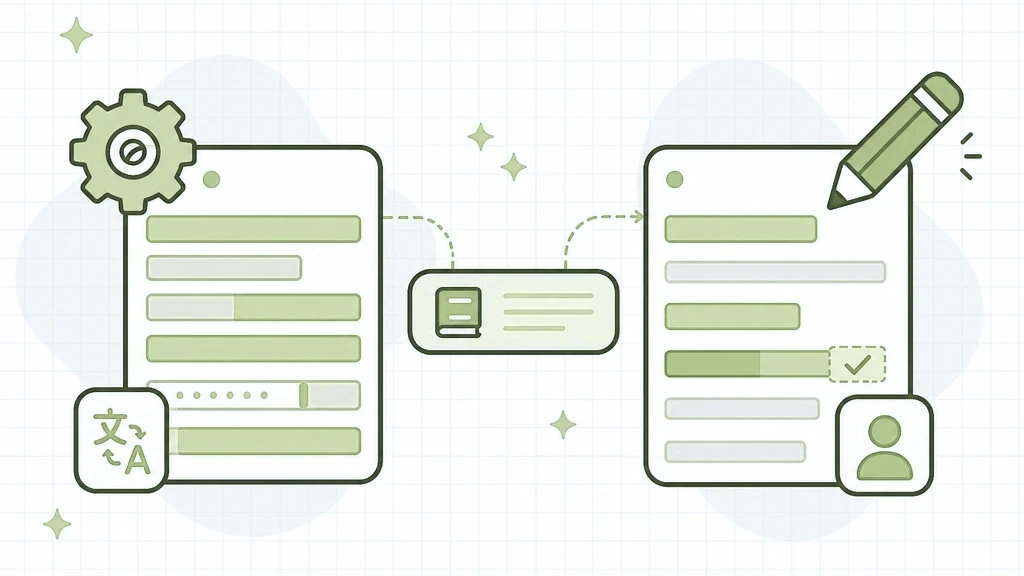
Localization managers face the same question on every website program: should we machine-translate and ship, pay for full human translation, or use machine translation post-editing (MTPE)? The honest answer depends on page type, risk, glossary maturity, and whether you can publish crawlable, people-first language versions—not on generic “MT is good now” hype.
This guide compares MTPE versus human translation for websites with operational criteria tied to multilingual SEO and helpful content expectations from Google and Bing. You will learn definitions, page-type fit, glossary and TM practices, legal and conversion guardrails, QA gates, and how to compare cost, speed, and risk without inventing statistics.
Quick answer: MTPE is edited MT, not raw publish
Short answer: MTPE is machine translation revised by a human editor before publish. Raw machine output pasted into localized URLs is not MTPE—and it often creates thin or mixed-language pages that fail people-first content expectations.
Google helpful-content guidance prioritizes people-first pages; thin or boilerplate-only language versions are weak SEO and weak answer sources. People-first helpful content expectations apply to every language version; low-quality machine-only pages can create thin or unhelpful locale experiences.
Use MTPE when speed and cost matter but a human must fix terminology, tone, and factual clarity. Use full human translation when brand voice, legal precision, or conversion copy cannot tolerate MT errors. Never skip QA gates for either path.
Definitions: MT, MTPE and human translation
Machine translation (MT) — automated conversion from source to target language with no guaranteed human review before publish.
Machine translation post-editing (MTPE) — MT followed by human editing (light or full) to meet quality thresholds before content ships.
Human translation — linguists translate from source without MT in the loop, or rewrite MT so thoroughly it is effectively new copy.
Boilerplate-only or poorly translated main content weakens language versions even when chrome is translated. Translating navigation while leaving body copy in the source language is a common failure mode—not a workflow choice.
Google determines page language primarily from visible content; language versions should keep content and navigation predominantly in one language.
Why quality matters for language-version SEO
Multilingual SEO starts with crawlable locale URLs—Google recommends different URLs per language rather than cookies alone—but quality determines whether those URLs deserve visibility.
Hreflang annotations tell Google about alternate language URLs and must be reciprocal when alternates exist. XML sitemaps help discovery and can carry hreflang. Canonicals should prefer same-language URLs when duplicates exist. None of these annotations rescue unhelpful body copy.
Translation quality affects:
- Language detection — mixed or sloppy text confuses users and algorithms reading visible content.
- Helpful content signals — thin MT pages add URLs without adding value.
- Trust on conversion and legal pages — errors carry business risk beyond SEO.
- Bing indexing — Bing Webmaster Guidelines emphasize crawlable, useful content and clear structure across markets.
Read international SEO versus multilingual SEO when strategy precedes workflow choice.
Page-type decision matrix
Not every page deserves the same workflow. A practical split:
MTPE-friendly (with glossary + review):
- Long-tail help articles with factual, repetitive structure
- Internal documentation mirrored publicly
- Product feature lists with stable terminology
- Glossary-backed UI strings and microcopy batches
Human-first or heavy MTPE:
- Homepage and core landing pages
- Pricing and plan comparison pages
- Customer stories and brand campaigns
- Highly idiomatic blog thought leadership
Human-only or legal review mandatory:
- Terms of service, privacy policies, regulatory disclosures
- Safety, medical, or financial claims
- Employment and contractual templates
Map workflows in a routing table during brief intake—not ad hoc per vendor quote.
Glossary, TM and style guides
MTPE reliability scales with terminology control:
- Glossary — approved product terms, forbidden translations, and market-specific variants.
- Translation memory (TM) — reuse vetted sentences; update TM after human corrections.
- Style guide — tone, formality, inclusivity, and punctuation per locale.
- Do-not-translate list — product names, integration labels, code tokens.
Without glossary enforcement, MTPE editors spend time fixing the same terminology errors on every page—erasing MT speed gains.
Feed MT engines glossary constraints where supported, then still run human post-edit on high-visibility URLs.
Risk pages: legal, brand and conversion
Legal, brand, and conversion pages need stricter gates:
- Legal — full human translation plus jurisdictional review; MTPE is rarely appropriate for binding text.
- Brand — taglines and campaigns often require transcreation, not literal MTPE.
- Conversion — pricing CTAs, guarantee language, and trial terms must be accurate; light MTPE may suffice for secondary markets only after testing.
Google advises against automatically redirecting users based on assumed language; pair high-quality localized copy with visible language selectors on crawlable URLs.
Avoid publishing raw MT on checkout, signup, or compliance flows even when marketing pages use MTPE.
QA and publish gates
After MTPE—or any translation—run QA before publish:
- Locale completeness — no empty fields or English fallbacks on localized URLs.
- Language consistency — body, nav, buttons, and errors match target locale.
- Terminology audit — sample against glossary and TM.
- Link and slug check — internal links stay in-locale; hreflang pairs reciprocal.
- Metadata review — localized titles and descriptions, not English duplicates.
- Spot human read — native speaker review on highest-traffic templates.
Block publish when sample pages fail helpful-content smell tests: thin, repetitive, or obvious MT artifacts on primary content.
Each language URL should remain a distinct crawlable URL with clear canonicals—quality QA includes technical checks, not just linguistic ones.
Cost, speed and risk tradeoffs
Compare workflows honestly:
| Dimension | Raw MT | MTPE | Human translation |
|---|---|---|---|
| Speed | Fastest | Fast with edit queue | Slowest |
| Cost | Lowest direct cost | Mid | Highest direct cost |
| SEO / UX risk | Highest | Moderate if gated | Lowest when well managed |
| Scales with glossary | Poorly | Well | Well with TM |
Hidden costs include rework after brand incidents, legal review cycles, support tickets from confused users, and de-indexing thin locale folders. A cheap MT launch that requires emergency human rewrite often costs more than planned MTPE.
Speed matters for launch deadlines—but publishing low-quality machine-only pages can create technical debt across hreflang clusters and sitemaps you must maintain later.
Implementation checklist
Traditional search and answer-engine foundations
Shared foundations for MTPE and human review quality on locale pages still matter across Google, Bing, and answer engines: crawlable language versions, clear entities, evidence-backed claims, structured data where truthful, and real localization—not English-only shells. Treat the guides below as platform-specific lenses on the same multilingual delivery bar.
Platform guide: Google Search
For Google Search, discovery depends on crawlable locale URLs with language-appropriate HTML, accurate titles/headings, and reciprocal hreflang when alternates exist. Technical foundations include indexable content (not cookie-only switches), localized metadata, sitemaps, and canonical discipline. Content quality means people-first main content in each language; authority comes from clear organization identity and corroborating sources—not translation-tool marketing. Multilingual implication: each market or language URL must stand alone. Measure with Search Console coverage and URL Inspection per locale. Known vs uncertain: Google documents multilingual and hreflang behavior; it does not guarantee rankings from any CMS or MTPE workflow.
Platform guide: Bing
Bing discovers and indexes crawlable multilingual pages with clear structure, similar to Google’s URL and content clarity expectations. Technical foundations include fetchable locale URLs, useful content, and Bing Webmaster Tools monitoring. Prefer localized headings, claims, and FAQs over chrome-only translation. Authority signals still depend on trustworthy sources and consistent entities. Multilingual implication: do not hide languages behind client-only toggles. Measure indexation and crawl stats in Bing Webmaster Tools. Known vs uncertain: Bing guidelines emphasize crawlable useful content; do not invent Bing-only ranking factors for translation tooling.
Platform guide: ChatGPT
ChatGPT may cite or summarize publicly accessible pages when language versions are clear and answer-ready. Discovery is not a conventional crawl ranking; visibility looks like being selected as a source or referenced in answers. Technical foundations still start with accessible HTML URLs—not widget overlays that hide copy. Content qualities that help include direct answers, FAQs, and stable terminology from glossaries. Authority comes from evidence and consistent entities across locales. Multilingual implication: each locale page should be readable on its own. Measurement is imperfect—treat citation checks as hypotheses. Known vs uncertain: there is no documented guarantee that MTPE or any CMS integration produces ChatGPT citations.
Platform guide: Gemini
Gemini and related Google AI experiences benefit from coherent entities, structured data where accurate, and indexable localized pages. Visibility is about being referenced or recognized—not inventing Gemini ranking factors. Technical foundations overlap Google Search crawlability and metadata quality. Content should present clear claims and definitions per language. Authority depends on organization consistency and corroboration. Multilingual implication: glossary-controlled product names reduce cross-locale confusion. Measure traditionally via Search Console and qualitatively sample AI answers. Known vs uncertain: Gemini behavior is not a substitute for documented Google Search guidance on hreflang and language versions.
Platform guide: Google AI Overviews
Google AI Overviews may link supporting pages; eligibility framing still rests on people-first, indexable content. They are not a language switch and do not replace hreflang. Technical foundations remain crawlable locale HTML and truthful structured data. Content qualities include concise answers and clear headings in each language. Authority signals mirror helpful-content expectations. Multilingual implication: Overview inclusion is not guaranteed for any translated page. Measure Search Console generative reports where available and keep traditional index metrics separate. Known vs uncertain: no translation workflow can promise Overview placement.
Where GlotEO fits
Choosing MTPE versus human translation is an operations problem spanning linguists, marketers, and engineering. GlotEO website localization platform helps teams route page types to appropriate workflows, enforce glossary and QA gates, and keep localized URLs aligned with briefs before anything reaches production.
Use multilingual SEO workflow tooling to connect translation decisions with hreflang, metadata, and locale matrix requirements. Review GlotEO pricing and plans when MTPE volume scales beyond spreadsheet tracking.
Ground strategy in international SEO versus multilingual SEO so quality investments follow language and country priorities—not generic translation volume targets.
Citations
- Supports guidance cited in this article (Bing Webmaster Guidelines)
- Supports guidance cited in this article (How to specify a canonical URL with rel=canonical and other methods)
- Supports guidance cited in this article (Creating helpful, reliable, people-first content)
- Supports guidance cited in this article (Tell Google about localized versions of your page)
- Supports guidance cited in this article (Managing multi-regional and multilingual sites)
- Supports guidance cited in this article (Learn about sitemaps)