



International Website Architecture: URL Structures That Scale
Choose crawlable international URL structures—ccTLDs, subdomains, or subdirectories—and align hreflang, canonicals and migrations without ranking promises.
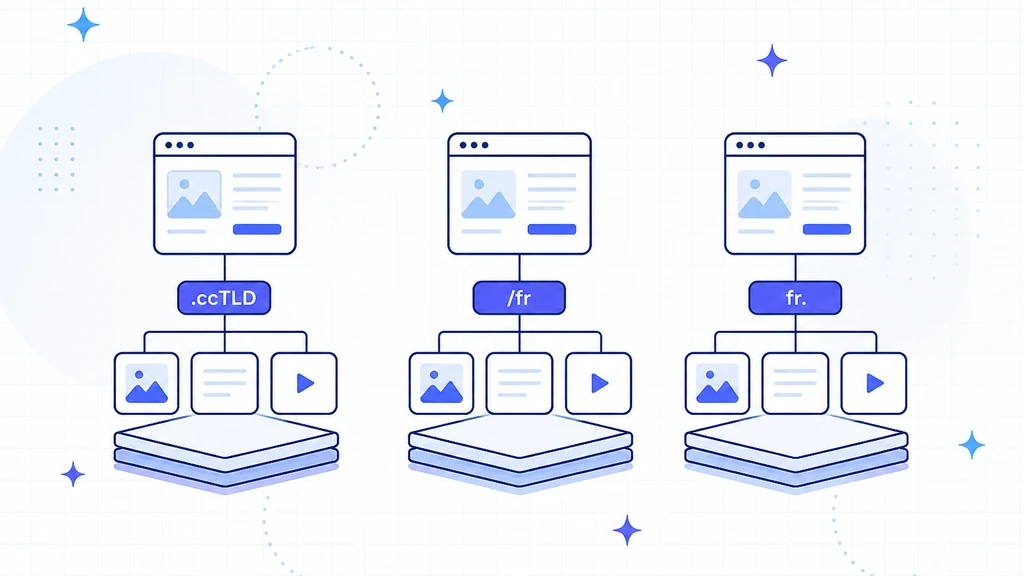
International website architecture is the decision layer beneath every multilingual and multi-regional SEO program. Before you commission translation, before you wire hreflang, and before you split catalogs by country, you need a URL pattern that search engines can crawl, that users can bookmark, and that your team can maintain for years. Google documents several locale-specific URL options, but none of them guarantee rankings. The payoff is clarity: each language and market version gets a distinct, discoverable address with consistent annotations.
This guide maps Google’s documented URL structures to real planning choices. It explains when ccTLDs, subdomains, and subdirectories fit, why parameters fail as primary geotargeting, and how hreflang and canonicals follow from architecture—not the other way around. For the strategy vocabulary behind language versus country targeting, See International SEO vs Multilingual SEO for strategy vocabulary.
Questions this guide answers
- What URL structures does Google document for international and multi-regional sites?
- When should teams choose ccTLDs, subdomains, or subdirectories?
- Why are URL parameters not recommended for geotargeting segmentation?
- How should architecture differ for language-only vs country targeting?
- How do hreflang and canonicals interact with URL architecture choices?
- What locale signals matter beyond the URL path?
- How should teams handle migrations between international URL structures?
- What architecture mistakes block crawlability of language or region versions?
Quick answer: architecture follows the market matrix
Start with a country × language matrix, not a folder name. For each cell, write what users in that market need: language comprehension, local currency, fulfillment rules, legal terms, or all of the above. The matrix tells you whether you need language-only paths (/de/), country-only paths (/us/), combined locale paths (/en-ca/), or separate ccTLDs (example.de).
Google recommends different URLs for each language version rather than switching language on a single URL via cookies or browser settings. Dynamic switching hides variants because Googlebot often crawls without Accept-Language and commonly from US infrastructure. Architecture is therefore a crawlability decision first and a branding decision second.
Once the matrix is stable, pick a structure your engineering and localization teams can operate for the next several years. Subdirectories on one gTLD are often the lowest-maintenance default. ccTLDs make sense when legal, brand, or hosting realities require hard market separation. Subdomains split the difference. URL parameters are documented but not recommended for geotargeting segmentation.
URL structures Google documents
Google’s multi-regional and multilingual documentation lists four locale-specific URL patterns. Each exposes a distinct address per version, which is the baseline requirement for crawlable language and region variants.
| Structure | Example | Country signal | Maintenance | User clarity | Google guidance |
|---|---|---|---|---|---|
| ccTLD (country-code domain) | example.de | Strong; tied to one country | Higher cost; separate hosts and certs | Clear local identity | Documented option; some vanity ccTLDs treated as gTLDs |
| Subdomain on a gTLD | de.example.com | Moderate; code alone does not set audience | Separate DNS and often separate stacks | Codes like de can mean language or country | Documented option; map audience explicitly |
| Subdirectory on a gTLD | example.com/de/ | Weaker alone; needs other signals | Usually lowest on one CMS host | Ambiguous unless labeled in UI | Documented option; often easiest to maintain |
| URL parameters | example.com?loc=de | Weak; easy to duplicate | Simple to prototype | Poor for sharing and bookmarks | Documented but not recommended for geotargeting |
None of these patterns alone determines rankings. Google treats them as ways to expose locale variants, not as automatic ranking boosts.
Choosing ccTLDs, subdomains, or subdirectories
Use decision criteria your organization can defend in a design review:
| Criterion | Favor ccTLD | Favor subdomain | Favor subdirectory |
|---|---|---|---|
| Legal or brand need for separate country domains | Yes | Sometimes | Rarely |
| Single CMS and shared component library | No | Partial | Yes |
| Engineering headcount for multi-host ops | Low | Medium | High |
| Strong country geotargeting priority | Yes | Partial | Partial |
| Language-only expansion (no country split) | Overkill | Works | Works well |
| Long-term migration flexibility | Harder | Moderate | Easier |
ccTLDs send a strong country signal but can be expensive, constrained, and limited to a single country. Google notes that some ccTLDs are treated as generic top-level domains, so confirm how your chosen TLD is classified before assuming country targeting.
Subdomains (de.example.com) offer flexible separation and can map to different backends. Google explicitly warns that subdomain codes are not used to determine target audience unless you map audience explicitly—for example with hreflang and consistent on-page cues.
Subdirectories (example.com/de/) are often the easiest setup on one host with lower ongoing maintenance. The trade-off is ambiguity: /de/ might mean German language worldwide, Germany in English, or German for Germany. Resolve intent in the matrix before you commit to folder names.
Why parameters fail as primary geotargeting
Google documents URL parameters as a locale option but does not recommend them for geotargeting segmentation. Parameters create predictable problems at scale:
- Crawl duplication. The same path with multiple
?loc=values can produce parameter permutations that dilute signals unless parameter handling is meticulously configured. - Weak user signals. Bookmarking, sharing, and printed materials prefer stable paths. Parameters hide locale identity in analytics and support tickets.
- Discovery gaps. Internal links, sitemaps, and hreflang clusters all need absolute URLs. Parameter-heavy architectures often ship with incomplete alternate sets.
- Migration debt. Moving from
?lang=frto/fr/later requires redirect maps across every indexed URL variant.
Parameters can still serve tracking or authenticated views, but not primary segmentation.
Language-only vs country architecture
Language-only and country-only programs need different URL shapes even when the underlying CMS is shared.
Language-only targeting (multilingual SEO) answers: which language should this user read? Typical patterns:
/en/,/es/,/ja/subdirectoriesen.example.com,es.example.comsubdomains- One global English site plus incremental language folders
Hreflang values are usually language codes alone: hreflang="en", hreflang="es". Canonical policy is straightforward when each URL is a true translation of the same page.
Country targeting (multi-regional SEO) answers: which market experience should this user get? Typical patterns:
- ccTLDs per country (
example.co.uk,example.com.au) - Country subdomains or folders (
uk.example.com,example.com/us/) - Combined locale folders when language and country both vary (
/en-us/,/en-gb/,/fr-ca/)
Hreflang values often use language-plus-region: hreflang="en-US", hreflang="en-GB". When the same language appears on multiple country URLs with near-duplicate content, Google advises picking a preferred version and using rel="canonical" together with hreflang.
Broader multilingual SEO program design sits above this URL-layer guide; this article owns architecture choices those programs depend on.
Hreflang and canonicals in the architecture
Hreflang and canonicals do not replace URL architecture—they annotate the URLs you chose. Google supports hreflang via HTML link tags, HTTP headers, or sitemaps; the methods are equivalent. Each localized URL should list itself and its alternates with fully qualified, reciprocal links. If two pages do not point to each other, hreflang tags may be ignored.
Architecture-driven hreflang rules:
- One URL per language or locale variant in the cluster
- Absolute URLs that match the canonical address users see
x-defaultfor unmatched languages, often pointing to a language selector or global fallback- Language codes alone (
de) or language-plus-region (de-AT) consistent with the matrix
Canonical interaction: When using hreflang, specify a canonical in the same language, or the best available substitute language if a same-language canonical does not exist. For similar same-language content on multi-regional URLs—German on both example.de and example.com/de/—pick a preferred URL and use canonical plus hreflang so Search can serve the correct regional URL without treating every duplicate as uncontrolled repetition.
Localized versions are only considered problematic duplicates when the main content remains untranslated. Small regional variations in one language are a legitimate alternate-page scenario.
This article summarizes hreflang at the architecture boundary. Return links, invalid region codes, sitemap versus HTML trade-offs, and cluster QA mechanics are covered in depth in treat hreflang cluster mechanics as a dedicated technical workstream—read that companion when you move from URL design to annotation implementation.
Locale signals beyond the path
URL structure is necessary but not sufficient. Google determines target locale using multiple signals:
| Signal | Role | Caveat |
|---|---|---|
| ccTLD | Strong country association | Vanity ccTLDs may behave as gTLDs |
| hreflang | Declares language/region alternates | Does not set page language by itself |
| Server location | Weak geotargeting hint | Imperfect with CDNs and multi-region hosting |
| On-page cues | Addresses, phone, currency, local language | Must reflect real market operations |
HTML lang | Accessibility and rendering | Not used by Google to detect page language |
Google ignores locational meta tags such as geo.position for geotargeting. Geotargeting is not exact, so provide user-facing links to choose region or language when someone lands on the wrong version. Google also notes that targeting a specific country can improve results in that country at the expense of other locales—a trade-off, not a promise of higher global visibility.
Language detection follows a different rule: Google determines language from visible content, not from URLs, lang attributes, or hreflang. Architecture must therefore deliver pages that are predominantly in one language for both content and navigation.
Sitemaps and discovery at scale
As locale count grows, sitemaps become a primary discovery path alongside internal linking. Google sitemaps can declare alternate language and region versions, helping crawlers find URLs that internal navigation might bury deep in faceted menus.
Include only canonical URLs, keep sitemaps current when markets change, and align sitemap hreflang entries with HTML or header annotations. Submit sitemaps in Search Console per property when ccTLDs split accounts. Structured data per locale can extend discovery beyond flat URL lists once URL and annotation foundations are stable.
Migration patterns between structures
Teams rarely get architecture perfect on the first launch. Common paths include subdirectory to ccTLD (legal separation), parameter to folder (restore crawlability), subdomain consolidation, and folder renames. Each requires a redirect map for every indexed locale URL—not just the homepage—plus hreflang and canonical updates in the same release.
Migration principles: freeze the matrix first, prefer direct 301s, point language switchers at new URLs immediately, and validate reciprocity weekly for the first month. Google does not document fixed recovery timelines; document technical completeness instead of traffic promises.
Architecture mistakes that hide locales
These failure modes block crawlability or confuse locale signals:
| Mistake | Why it hurts |
|---|---|
| Cookie or browser language on one URL | Crawlers may never see non-default languages |
| Forced IP or Accept-Language redirects | Hides alternates from users and bots that need explicit URLs |
| Parameter-primary segmentation | Weak URLs, duplication risk, poor hreflang hygiene |
| Ambiguous folder codes without hreflang | /de/ might be language, country, or both—Search lacks clarity |
| ccTLD + gTLD duplicates without canonical | Same-language content on example.de and example.com/de/ conflicts |
| Locale versions blocked by robots.txt | Architecture exists but is not crawlable |
| hreflang pointing at redirects or 404s | Breaks cluster reciprocity |
| JavaScript-only locale routing | If rendered URLs differ from crawl paths, discovery fails |
The most expensive mistake is treating architecture as cosmetic: launching translated chrome on URLs that still serve monolingual body copy, or splitting countries without updating fulfillment data on the page. Users and search systems both read what is visible.
Implementation checklist
Search-engine crawling and indexing
Googlebot and Bing crawlers need stable, linkable language or country URLs—whether ccTLD, subdomain, or subdirectory. Architecture choices affect crawl budget, canonical clusters, and hreflang maps. Keep locale versions in HTML that bots can fetch without depending on opaque client-only routing. Measure index coverage per host or folder in Google Search Console and Bing Webmaster Tools.
Answer-engine access, source selection and multilingual understanding
Answer engines generally need the same reachable URLs humans can open. If a language version exists only behind authentication, blocked scripts, or volatile parameters, it is a weak candidate for citations or source inclusion. Prefer stable locale paths, clear page purpose, and consistent entity information across languages so assistants can recognize the same organization in French, German, or Japanese. Architecture does not create guaranteed citations; it removes accidental barriers to access and understanding.
Planned follow-ons: platform-specific optimization guides for Google, Bing, ChatGPT, Claude, Gemini, Perplexity, and Microsoft Copilot.
Optimizing for Google Search
Choose URL patterns Google can crawl and map with hreflang: stable hosts or folders, HTML language versions, and clear internal links between locales. Document known limits explicitly: do not invent ranking factors, and separate traditional index metrics from answer-engine citation checks.
Optimizing for Bing
Mirror crawlability for Bingbot and validate locale hosts/paths in Bing Webmaster Tools. Document known limits explicitly: do not invent ranking factors, and separate traditional index metrics from answer-engine citation checks.
Platform guide: ChatGPT
Assistants need reachable locale URLs. Client-only language switchers that hide alternate HTML block source access. Document known limits explicitly: do not invent ranking factors, and separate traditional index metrics from answer-engine citation checks.
Platform guide: Claude
Authoritative local documentation must be server-reachable—architecture that traps copy in apps weakens Claude as a source consumer. Document known limits explicitly: do not invent ranking factors, and separate traditional index metrics from answer-engine citation checks.
Platform guide: Gemini
Indexable locale architecture remains the practical base for Google ecosystem AI experiences. Document known limits explicitly: do not invent ranking factors, and separate traditional index metrics from answer-engine citation checks.
Platform guide: Perplexity
Stable language URLs improve citation durability versus parameter-only locale hacks. Document known limits explicitly: do not invent ranking factors, and separate traditional index metrics from answer-engine citation checks.
Platform guide: Microsoft Copilot
Where Copilot discovery relates to Bing indexing, keep Bing-indexable multilingual architecture—without inventing Copilot-specific ranking factors. Document known limits explicitly: do not invent ranking factors, and separate traditional index metrics from answer-engine citation checks.
Where GlotEO fits
Architecture decisions belong to engineering and SEO leadership, but they fail without content workflows that keep every locale URL aligned with translated pages, annotations, and QA checklists. GlotEO’s multilingual SEO solution supports that editorial layer for multilingual and international programs—helping teams ship crawlable language versions on the URL patterns you choose, without replacing the matrix and migration work above.
For ongoing measurement, plan Search Console property splits, hreflang reporting, and coverage checks across locale versions. Structured data at scale can follow once foundations are stable.
Teams that need editorial control across locales can use GlotEO’s multilingual SEO platform, then compare GlotEO pricing and plans.
Citations
- Supports guidance cited in this article (How to specify a canonical URL with rel=canonical and other methods)
- Supports guidance cited in this article (Tell Google about localized versions of your page)
- Supports guidance cited in this article (Managing multi-regional and multilingual sites)
- Supports guidance cited in this article (Learn about sitemaps)