



International Keyword Research
A market-first process for multilingual keyword research: language vs country frames, local SERP validation, URL matrices, and Search Console measurement—without translating English seeds alone.
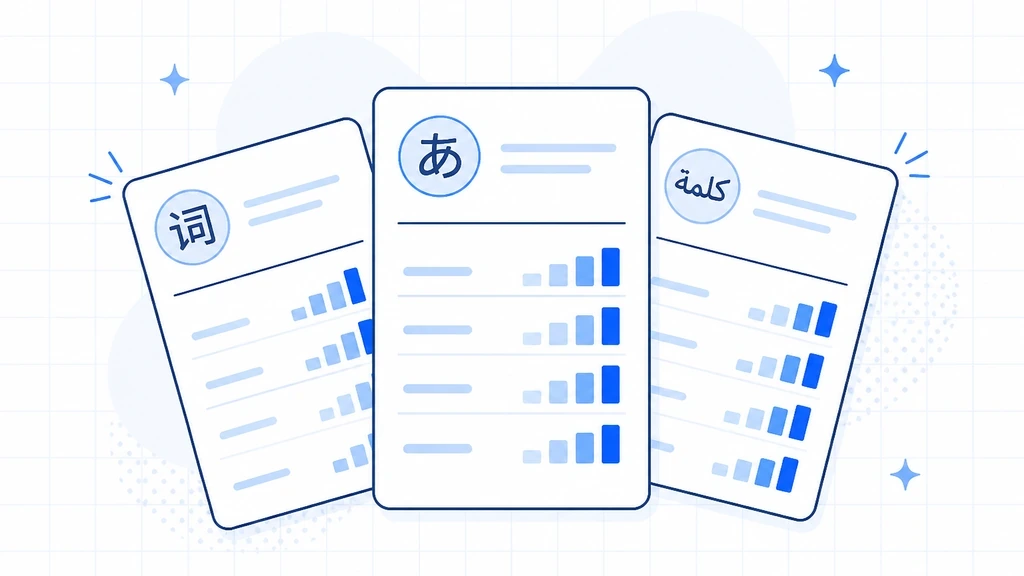
International keyword research is not a translation exercise. Search demand, query language, and SERP layouts differ by market even when the product is identical. Teams that export English seed lists through a dictionary—and call it research—often publish crawlable language URLs that do not match how people actually search locally.
This guide teaches a market-first process: frame language versus country targeting, build seed lists per market, validate intent in local SERPs, and connect findings to URL and content matrices—grounded in Google’s multilingual site guidance, not invented ranking shortcuts.
Questions this guide answers
- Why is translating English keywords insufficient for international SEO?
- How should language targeting and country targeting change keyword sets?
- What process builds seed lists per market?
- How do you validate local search intent and SERP features?
- How should keyword research inform URL and content matrices?
- How do you handle one language across multiple countries?
- What tools and Search Console signals support ongoing research?
- Which international keyword research mistakes are most common?
Quick answer: research demand in-market, do not only translate
Quick answer: Research keywords in each target language and market using local tools, SERP inspection, and post-launch Search Console data—not by translating English seeds word-for-word. Google distinguishes multi-regional and multilingual sites; your keyword sets should follow whether you target languages, countries, or both. Geotargeting signals are imperfect; local language, currency, and on-page cues still matter alongside hreflang and URL structure.
Translating English keywords tells you what words could be used. It does not tell you what users do search for, which SERP features appear, or whether intent matches your page type.
Language vs country keyword frames
How should language targeting and country targeting change keyword sets?
Google defines multilingual sites as offering content in more than one language and multi-regional sites as explicitly targeting users in different countries. Keyword planning must mirror that split:
| Frame | Keyword question | Example |
|---|---|---|
| Language | How do speakers of this language query? | French queries for Canada vs France |
| Country | How do buyers in this market query in their preferred language? | German queries in Austria vs Germany |
| Combined | Which language × country cells need distinct URL targets? | en-US vs en-GB pricing terms |
When you target a language globally, one keyword set may suffice with regional spelling variants noted. When you target countries separately—even in one language—currency, shipping, regulations, and competitive SERPs can change the keyword list entirely.
Google recommends different crawlable URLs for each language or region version rather than relying on cookies or browser language alone. Keyword research should inform which URLs earn investment, not the reverse.
Google advises against automatically redirecting users based on assumed language or location, and recommends a user-visible language or country selector. Research should respect that users may land on the “wrong” locale URL and switch manually.
Seed list process per market
What process builds seed lists per market?
Use a repeatable pipeline per language or country cell:
- Define the cell — language only, country only, or combined (e.g.,
es-MX) - Gather jobs-to-be-done — interviews, support tickets, sales calls, existing analytics
- Collect competitor and SERP-visible terms — inspect top results in the local Google interface (or Bing where relevant)
- Expand with local-language tools — autosuggest, related searches, People Also Ask
- Merge English source concepts as hints only — map ideas, not literal strings
- Dedupe and cluster — group by intent (informational, commercial, transactional)
- Prioritize by business fit — not raw volume alone
- Document approved phrasing — feed localization glossaries where terms are stable
Each cell gets its own seed document. Shared languages across countries (Spanish in Mexico and Spain, English in the US and UK) still warrant separate passes when SERPs or offers differ.
Intent and SERP validation
How do you validate local search intent and SERP features?
Volume metrics without SERP context mislead international teams. For each priority cluster:
- Search the term in the target market interface (correct country proxy or native reviewers)
- Classify intent: guide, comparison, product page, local pack, etc.
- Note SERP features: AI Overviews, featured snippets, video, marketplace dominance
- Compare winning page types—not just keywords—to your planned template
- Flag English-only SERP dominance (may signal need for localized proof, not English reuse)
Google determines page language primarily from visible content; language versions should keep content and navigation predominantly in one language. Intent validation ensures you build the right page type in the right language—not a translated blog post where the SERP expects a product comparison.
Google helpful-content guidance prioritizes people-first pages; thin or boilerplate-only language versions are weak SEO and weak answer sources. If local intent requires market-specific examples, pricing, or compliance copy, keyword approval should trigger localization depth—not word-for-word translation.
From keywords to content and URL matrices
How should keyword research inform URL and content matrices?
Turn keyword clusters into an explicit matrix:
| Market cell | Primary cluster | Page type | URL pattern | hreflang code |
|---|---|---|---|---|
| de-DE | “website übersetzen” | Guide | /de/blog/... | de-DE |
| fr-CA | “traduction site web” | Guide | /fr-ca/... | fr-CA |
Rules of thumb:
- One primary intent per URL; avoid multi-intent mashups
- Align title, H1, and body language with the approved local cluster
- Hreflang annotations tell Google about alternate language or regional URLs and must be reciprocal across the set of pages they describe
- Each language or locale URL should have a clear canonical that prefers the same-language preferred URL when duplicates exist
- XML sitemaps help discovery of language versions and can carry hreflang annotations when used as an implementation method
Keyword research should drive which rows exist in the matrix—not justify cloning every English URL regardless of demand.
Shared language across countries
How do you handle one language across multiple countries?
English in the US and UK, Spanish in Mexico and Spain, and Portuguese in Brazil and Portugal are common pain points.
Options:
- Single URL with generic language code (
en,es) when content truly serves all speakers and offers do not differ - Regional URLs (
en-US,en-GB) when pricing, shipping, spelling, or regulatory copy differs - Hybrid — global
enfallback plus regional overrides for high-stakes pages (pricing, legal)
Geotargeting signals are imperfect; local language, currency, and on-page cues still matter alongside hreflang and URL structure. Even with regional hreflang, inspect whether SERPs differ enough to warrant separate keyword targets and page templates.
Provide user-visible switchers; do not force redirects that hide alternate versions from crawlers and users.
Measurement with Search Console and analytics
What tools and Search Console signals support ongoing research?
Official search documentation does not prescribe a single keyword toolchain. Treat tool choice as operational. Google Search Console (and Bing Webmaster Tools where indexed) supplies post-launch truth:
- Queries and pages filtered by property or subdirectory per locale
- Impressions and CTR shifts after localization
- Index coverage and hreflang errors after matrix changes
- Compare query language to on-page language for drift
Bing Webmaster Guidelines emphasize crawlable, useful content and clear site structure for indexing across markets—measurement should confirm Bing can crawl locale URLs you care about, not only Google.
Refresh seed lists quarterly in mature markets; monthly during aggressive launch phases. Feed winning queries back into glossaries as approved variants.
Implementation checklist
Common mistakes
Which international keyword research mistakes are most common?
- Translating English seeds verbatim without local SERP validation
- Ignoring country differences within the same language
- Choosing URLs before research and forcing keywords to fit
- Treating volume as intent without inspecting SERP layout
- Skipping glossary handoff so approved terms drift in translation
- Publishing thin translated templates that fail helpful-content expectations
- Cookie-based locale switching without crawlable language URLs
- Non-reciprocal hreflang after launching matrix rows
- Same-language duplicates without clear canonical preference
- One-time research with no Search Console feedback loop
Deeper SERP validation patterns
When validating intent, capture three artifacts per priority cluster: a screenshot or notes on dominant page type, a list of recurring modifiers (pricing, free, enterprise, near me), and whether results skew editorial or product-led. Clusters where the SERP shows local packs, marketplaces, or AI Overviews may need different templates than a translated English blog post.
Re-run validation when Google refreshes SERP layouts in a market—especially for YMYL topics where local compliance language appears in titles. A keyword that looked informational six months ago may have shifted commercial.
Connecting research to glossaries and translation
Approved keyword phrasing should flow into localization glossaries as preferred renderings—not as mandatory insertions in every sentence, but as constraints on titles, H1s, and anchor text where research supports it. This closes the loop between SEO research and translation quality: linguists see why a term matters, and SEOs trust published copy to reflect local demand.
Without glossary handoff, teams often publish crawlable URLs whose visible language does not match the queries they researched—undermining both user trust and the clarity Google expects from people-first pages.
Budget mistakes that look like research
Which international keyword research mistakes are most common? Beyond the list above, watch for:
- Researching once per language when country SERPs differ materially
- Letting English information architecture dictate local content types
- Ignoring zero-volume strategic terms that appear in sales cycles but not keyword tools
- Skipping Bing validation in markets where Bing share matters for B2B
- Launching hreflang clusters before keyword-to-URL mapping is stable—forcing rework across annotations
Research is cheaper than rewriting fifty localized URLs because hreflang and canonical rules were built on the wrong intent map.
Tooling boundaries
Official Google and Bing documentation describe crawlability, language clarity, and helpful content—they do not endorse a single keyword research product. Treat tools as interchangeable inputs to the process above: local autosuggest, SERP scraping, Search Console, analytics landing pages, and customer language from support tickets.
Document which tool produced each seed list so teams can reproduce research during audits. The process matters more than the vendor logo on the export.
Matrix maintenance
URL and content matrices are living documents. When English pillars rename or merge, update matrix rows before retranslation propagates outdated paths. Pair matrix changes with hreflang regression checks—reciprocal annotations break silently when URLs move but annotations lag.
For shared languages across countries, maintain a column for spellingVariant, currency, and legalOwner so keyword research maps to the correct regional URL—not an assumed default.
Post-launch iteration cadence
Schedule a 30-day and 90-day review for each new locale cell. At 30 days, inspect index coverage and first-query impressions in Search Console; at 90 days, compare winning queries to your seed clusters and update glossaries with phrasing that already earns visibility. Markets that underperform often need template changes—not more translated pages from the English backlog.
Invite localization leads to these reviews so keyword learnings become enforced terminology rather than one-off SEO notes.
Keep a “SERP snapshot” appendix per cluster: date, market, dominant page types, and notes on regulatory language in titles. Future you—and future vendors—will need that context when refreshing seeds.
Document who owns each market cell in the matrix so research updates do not stall waiting for a single global SEO lead.
Traditional search and answer-engine foundations
Shared foundations for in-market keyword research feeding locale content still matter across Google, Bing, and answer engines: crawlable language versions, clear entities, evidence-backed claims, structured data where truthful, and real localization—not English-only shells. Treat the guides below as platform-specific lenses on the same multilingual delivery bar.
Platform guide: Google Search
For Google Search, discovery depends on crawlable locale URLs with language-appropriate HTML, accurate titles/headings, and reciprocal hreflang when alternates exist. Technical foundations include indexable content (not cookie-only switches), localized metadata, sitemaps, and canonical discipline. Content quality means people-first main content in each language; authority comes from clear organization identity and corroborating sources—not translation-tool marketing. Multilingual implication: each market or language URL must stand alone. Measure with Search Console coverage and URL Inspection per locale. Known vs uncertain: Google documents multilingual and hreflang behavior; it does not guarantee rankings from any CMS or MTPE workflow.
Platform guide: Bing
Bing discovers and indexes crawlable multilingual pages with clear structure, similar to Google’s URL and content clarity expectations. Technical foundations include fetchable locale URLs, useful content, and Bing Webmaster Tools monitoring. Prefer localized headings, claims, and FAQs over chrome-only translation. Authority signals still depend on trustworthy sources and consistent entities. Multilingual implication: do not hide languages behind client-only toggles. Measure indexation and crawl stats in Bing Webmaster Tools. Known vs uncertain: Bing guidelines emphasize crawlable useful content; do not invent Bing-only ranking factors for translation tooling.
Platform guide: ChatGPT
ChatGPT may cite or summarize publicly accessible pages when language versions are clear and answer-ready. Discovery is not a conventional crawl ranking; visibility looks like being selected as a source or referenced in answers. Technical foundations still start with accessible HTML URLs—not widget overlays that hide copy. Content qualities that help include direct answers, FAQs, and stable terminology from glossaries. Authority comes from evidence and consistent entities across locales. Multilingual implication: each locale page should be readable on its own. Measurement is imperfect—treat citation checks as hypotheses. Known vs uncertain: there is no documented guarantee that MTPE or any CMS integration produces ChatGPT citations.
Platform guide: Gemini
Gemini and related Google AI experiences benefit from coherent entities, structured data where accurate, and indexable localized pages. Visibility is about being referenced or recognized—not inventing Gemini ranking factors. Technical foundations overlap Google Search crawlability and metadata quality. Content should present clear claims and definitions per language. Authority depends on organization consistency and corroboration. Multilingual implication: glossary-controlled product names reduce cross-locale confusion. Measure traditionally via Search Console and qualitatively sample AI answers. Known vs uncertain: Gemini behavior is not a substitute for documented Google Search guidance on hreflang and language versions.
Platform guide: Google AI Overviews
Google AI Overviews may link supporting pages; eligibility framing still rests on people-first, indexable content. They are not a language switch and do not replace hreflang. Technical foundations remain crawlable locale HTML and truthful structured data. Content qualities include concise answers and clear headings in each language. Authority signals mirror helpful-content expectations. Multilingual implication: Overview inclusion is not guaranteed for any translated page. Measure Search Console generative reports where available and keep traditional index metrics separate. Known vs uncertain: no translation workflow can promise Overview placement.
Where GlotEO fits
International keyword research connects to execution: approved terms, localized drafts, and crawlable language URLs must stay aligned. GlotEO multilingual SEO platform helps teams tie research outputs to briefs, glossaries, and publishing workflows instead of losing clusters in disconnected spreadsheets.
Pair research with how international SEO differs from multilingual SEO when framing language versus country targets. Review GlotEO pricing and plans when scaling research-driven locale expansion across many URLs.
Explore GlotEO multilingual SEO to operationalize market-first keyword research alongside translation and site architecture work.
Citations
- Supports guidance cited in this article (Bing Webmaster Guidelines)
- Supports guidance cited in this article (How to specify a canonical URL with rel=canonical and other methods)
- Supports guidance cited in this article (Creating helpful, reliable, people-first content)
- Supports guidance cited in this article (Tell Google about localized versions of your page)
- Supports guidance cited in this article (Managing multi-regional and multilingual sites)
- Supports guidance cited in this article (Learn about sitemaps)