



Global Content Strategy
Define a global content operating model—markets, localization depth, ownership and URL alignment—before scaling translation volume across languages and regions.
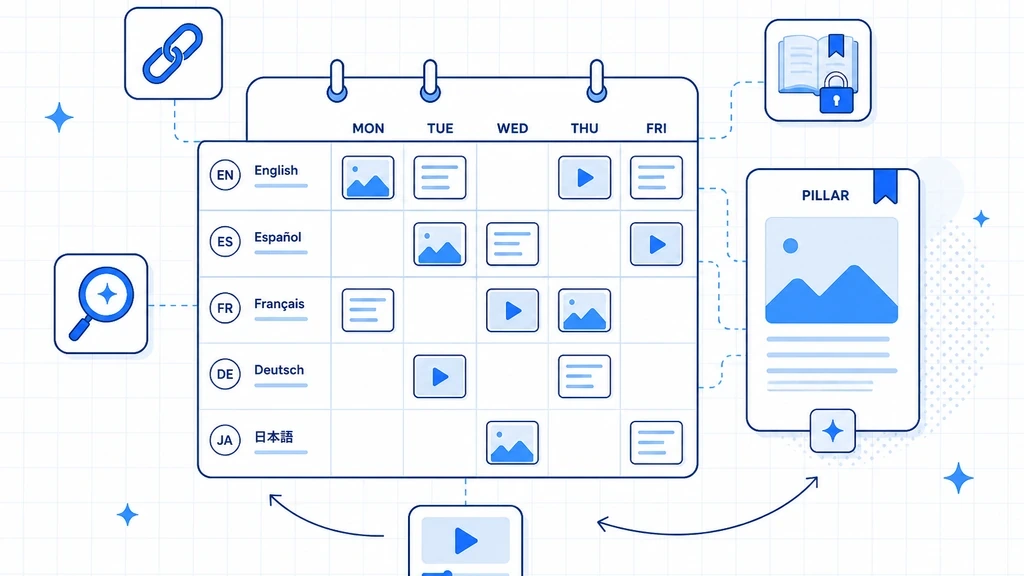
A global content strategy decides which markets, languages, and page types deserve investment—and at what localization depth—before translation volume becomes the plan. Without that layer, teams accumulate a translation backlog: every English URL queued for export, regardless of demand, intent, or operational readiness.
This guide defines global content strategy as an operating model grounded in multilingual SEO architecture: global versus local layers, market prioritization, translation versus localization choices, ownership, URL alignment, measurement by maturity, and careful AI search implications—without cloning thin English pages into new locales.
Questions this guide answers
- What is a global content strategy versus a translation backlog?
- How should teams prioritize markets and page types?
- How do translation vs localization decisions shape the content model?
- How should global, regional and local content layers interact?
- What operating model connects SEO, content and localization?
- How should measurement differ by market maturity?
- How do AI search and answer engines change global content planning?
- Which global content strategy mistakes waste budget?
Quick answer: strategy before translation volume
Quick answer: A global content strategy prioritizes markets, page types, and localization depth based on demand and business fit. A translation backlog simply queues English URLs for export. Successful multi-regional and multilingual programs start from clear targeting choices—language, country, or both—before scaling translated page volume. Helpful, people-first content expectations apply in every market; cloning thin English pages into new locales does not create strong language versions.
Strategy answers where and why; translation execution answers how much and how fast.
Global vs local content layers
How should global, regional and local content layers interact?
Think in three layers:
| Layer | Owns | Examples |
|---|---|---|
| Global | Brand story, core product narrative, compliance baselines | Homepage positioning, security whitepapers |
| Regional | Market-specific offers, regulations, campaigns | EMEA pricing, APAC events |
| Local | Language-native demand capture, local proof | In-market case studies, local SEO guides |
Global layers provide reusable source truth. Regional layers adapt go-to-market motion. Local layers capture search demand and cultural context that global copy cannot.
Each layer still needs crawlable language URLs when you target multilingual audiences. Google recommends using different crawlable URLs for each language or region version rather than relying on cookies or browser language alone. Layering strategy must map to URLs and hreflang—not only to folder taxonomy in a CMS.
Google determines page language primarily from visible content; language versions should keep content and navigation predominantly in one language. Mixing layers on one URL without a clear predominant language weakens that signal.
Prioritizing markets and page types
How should teams prioritize markets and page types?
Prioritize with a simple scorecard per market cell (language × country):
- Revenue or pipeline potential
- Competitive intensity in local SERPs
- Operational readiness (shipping, billing, support)
- Legal and compliance complexity
- Existing indexed footprint and Search Console baseline
For page types, sequence investment:
- High-intent commercial pages — pricing, product, integrations (when offers differ)
- Demand-capture content — guides matching validated local keywords
- Support and trust — docs, security, status
- Long-tail editorial — only after core templates perform
Avoid translating the entire English blog on day one. Google helpful-content guidance prioritizes people-first pages; thin or boilerplate-only language versions are weak SEO and weak answer sources.
Translation vs localization in the content model
How do translation vs localization decisions shape the content model?
Translation transfers meaning between languages. Localization adapts meaning, examples, currency, legal copy, imagery, and offers for a market. The content model should tag each template with allowed depth:
- Translate only — stable product facts with low market variance
- Localize — pricing, promotions, legal, market proof
- Transcreate — campaigns and emotionally resonant landing pages
- Hold global — content that must stay identical for compliance
Localization depth should follow keyword and SERP research—not default to full transcreation everywhere. When main content stays untranslated while only chrome localizes, language versions read as thin to users and search systems alike.
Operating model and ownership
What operating model connects SEO, content and localization?
Run global content as a RACI-connected program:
| Function | Owns |
|---|---|
| SEO | Market matrix, keyword research, hreflang/canonical policy |
| Content | Pillars, briefs, editorial calendar per layer |
| Localization | Glossaries, TM, vendor management, MTPE quality |
| Engineering | URL patterns, sitemaps, CMS locale delivery |
| Regional marketing | Local campaigns and market-specific offers |
Cadence: quarterly strategy reviews, monthly locale launch gates, weekly publish sync for active markets. Briefs should reference approved research and required sources before drafts enter translation.
Google advises against automatically redirecting users based on assumed language or location, and recommends a user-visible language or country selector. Operating models should include user choice—not forced redirects that hide alternate crawlable URLs.
Architecture alignment: URLs and annotations
Global strategy fails when content plans ignore URL reality. Align decisions with technical foundations:
- Distinct crawlable URLs per language version
- Hreflang annotations that are reciprocal across alternate sets
- Same-language canonical preferences when regional duplicates exist
- XML sitemaps that help discovery and can carry hreflang when used as an implementation method
Bing Webmaster Guidelines also emphasize crawlable, useful content and clear site structure for indexing across markets. Architecture alignment is not optional for Bing-visible locales.
Strategy documents should include a living URL matrix keyed to content pillars—not an appendix engineers receive after copy is already translated.
Measurement by market maturity
How should measurement differ by market maturity?
| Maturity | Focus metrics | Actions |
|---|---|---|
| Pre-launch | Research coverage, brief approval, staging crawl checks | Block launch on hreflang/canonical gaps |
| Early launch | Index coverage, impressions, critical query clusters | Fix thin templates; expand high-intent URLs |
| Growth | CTR, conversions, share of local SERP features | Invest in localization depth where ROI appears |
| Maintenance | Drift audits, glossary/TM freshness, annotation health | Retire stale URLs; refresh winning content |
One global dashboard rarely fits all cells. Search Console filtered by property or subdirectory supplies locale-specific query truth once URLs are live.
AI search implications for global content
How do AI search and answer engines change global content planning?
AI experiences reward the same fundamentals Google and Bing already emphasize: crawlable URLs, clear language, consolidated duplicates, and people-first content. Helpful, people-first content expectations apply in every market; cloning thin English pages into new locales does not create strong language versions or reliable answer sources.
Practical adjustments for global programs:
- Put direct, citable answers near the top of high-intent guides in each language
- Keep entity labels consistent across locales (glossary discipline)
- Avoid mixed-language templates that confuse visible-language detection
- Do not promise AI citations or rankings from localization tactics alone
AI search increases the cost of publishing thin translated shells—but it does not replace hreflang, canonical, or sitemap discipline.
Implementation checklist
Which global content strategy mistakes waste budget?
Which global content strategy mistakes waste budget? The expensive ones share a pattern: translation volume scales before strategy, architecture, or measurement matures.
- Translating the full English library before validating demand per market cell
- Treating localization as a post-publish step instead of tagging depth in the content model
- Launching locales without URL/hreflang matrices—forcing emergency fixes under traffic
- Running one global KPI dashboard that hides weak early markets until budget is spent
- Reusing English campaign creative where transcreation was required
- Neglecting glossary and TM governance so rebrands require full retranslation
- Auto-redirecting users by IP instead of offering crawlable alternates and visible switchers
- Publishing boilerplate-only language versions that fail helpful-content expectations
- Assuming AI search removes the need for crawlable, language-clear pages
- Splitting SEO, content, and localization budgets without shared ownership of the market matrix
Budget is best spent on fewer, deeper locale experiences than on shallow copies of every English URL.
Regional governance rhythms
Quarterly global content councils should review: market scorecards, pillar performance by layer (global/regional/local), annotation health, and upcoming launches blocked on research—not on translation vendor capacity alone. Monthly locale gates approve briefs only when keyword research, glossary entries, and URL targets align.
Document decisions in briefs engineers and vendors can execute without re-asking strategy questions every sprint.
Content model tags teams can implement now
Tag each template with: layer (global/regional/local), localizationDepth (translate/localize/transcreate), owner, and marketCells (which hreflang codes may use it). CMS filters then show what is safe to machine-translate versus what requires in-market review—preventing accidental MT on regulated pages while speeding repetitive docs.
AI search and entity clarity across locales
Answer engines and AI Overviews surface content that is crawlable, clearly written, and trustworthy in the user’s language. Global programs that clone thin English pages without glossary discipline produce alternate URLs that are technically valid but weak answer sources. Invest in direct answers and consistent entity labels per locale—not keyword-stuffed clones.
Bing Webmaster Guidelines emphasize crawlable structure and useful content across markets; the same bar applies when planning which locales earn AI-visible guides versus lightweight translations.
Stakeholder alignment workshops
Run a half-day workshop per new region: SEO presents keyword clusters, content presents pillar gaps, localization presents glossary/TM readiness, engineering confirms URL and sitemap plans. Decisions captured in the brief prevent the translation backlog from filling before the strategy is signed off.
When leadership asks for “all pages in six languages,” respond with a phased matrix: wave one high-intent URLs, wave two demand-capture content, wave three long tail—each wave gated on measurement from the prior wave.
Measurement handoffs between teams
SEO should own annotation health dashboards; content owns pillar completion by layer; localization owns glossary/TM version stamps on each release. When metrics disagree—high impressions but weak conversions—revisit localization depth tags before adding more translated URLs.
Early markets deserve patience on conversion metrics while indexation and query coverage mature; mature markets should justify continued spend with localized ROI, not English parity counts.
Strategy documents should name stop rules: conditions that pause translation spend—for example, persistent hreflang errors, sub-threshold indexation after 90 days, or glossary violation rates above an agreed threshold. Stop rules protect budget better than annual reforecasting alone.
Finally, treat English source pages as one input to global planning, not the automatic template list. Some markets need net-new local pillars; others need only pricing and product pages. The matrix makes that visible before vendors quote word counts.
Publish the market matrix where content, SEO, and localization leads can comment asynchronously—strategy fails when it lives only in slide decks.
Review stop rules quarterly: if a locale still shows thin template indexation after two refresh cycles, deprioritize new translation volume until depth improves.
When leadership requests parity with English page counts, respond with the matrix and stop rules above—parity without demand evidence is how global content strategy collapses into an expensive translation backlog.
Strong global content strategy is visible in operational artifacts: an approved matrix, tagged templates, glossary versions tied to releases, and locale dashboards—not in translated page counts alone.
Revisit the matrix after every major English information-architecture change so localized URLs do not inherit obsolete paths by default.
That discipline keeps global content strategy ahead of translation volume instead of chasing it.
Traditional search and answer-engine foundations
Shared foundations for global content operating models across markets still matter across Google, Bing, and answer engines: crawlable language versions, clear entities, evidence-backed claims, structured data where truthful, and real localization—not English-only shells. Treat the guides below as platform-specific lenses on the same multilingual delivery bar.
Platform guide: Google Search
For Google Search, discovery depends on crawlable locale URLs with language-appropriate HTML, accurate titles/headings, and reciprocal hreflang when alternates exist. Technical foundations include indexable content (not cookie-only switches), localized metadata, sitemaps, and canonical discipline. Content quality means people-first main content in each language; authority comes from clear organization identity and corroborating sources—not translation-tool marketing. Multilingual implication: each market or language URL must stand alone. Measure with Search Console coverage and URL Inspection per locale. Known vs uncertain: Google documents multilingual and hreflang behavior; it does not guarantee rankings from any CMS or MTPE workflow.
Platform guide: Bing
Bing discovers and indexes crawlable multilingual pages with clear structure, similar to Google’s URL and content clarity expectations. Technical foundations include fetchable locale URLs, useful content, and Bing Webmaster Tools monitoring. Prefer localized headings, claims, and FAQs over chrome-only translation. Authority signals still depend on trustworthy sources and consistent entities. Multilingual implication: do not hide languages behind client-only toggles. Measure indexation and crawl stats in Bing Webmaster Tools. Known vs uncertain: Bing guidelines emphasize crawlable useful content; do not invent Bing-only ranking factors for translation tooling.
Platform guide: ChatGPT
ChatGPT may cite or summarize publicly accessible pages when language versions are clear and answer-ready. Discovery is not a conventional crawl ranking; visibility looks like being selected as a source or referenced in answers. Technical foundations still start with accessible HTML URLs—not widget overlays that hide copy. Content qualities that help include direct answers, FAQs, and stable terminology from glossaries. Authority comes from evidence and consistent entities across locales. Multilingual implication: each locale page should be readable on its own. Measurement is imperfect—treat citation checks as hypotheses. Known vs uncertain: there is no documented guarantee that MTPE or any CMS integration produces ChatGPT citations.
Platform guide: Gemini
Gemini and related Google AI experiences benefit from coherent entities, structured data where accurate, and indexable localized pages. Visibility is about being referenced or recognized—not inventing Gemini ranking factors. Technical foundations overlap Google Search crawlability and metadata quality. Content should present clear claims and definitions per language. Authority depends on organization consistency and corroboration. Multilingual implication: glossary-controlled product names reduce cross-locale confusion. Measure traditionally via Search Console and qualitatively sample AI answers. Known vs uncertain: Gemini behavior is not a substitute for documented Google Search guidance on hreflang and language versions.
Platform guide: Google AI Overviews
Google AI Overviews may link supporting pages; eligibility framing still rests on people-first, indexable content. They are not a language switch and do not replace hreflang. Technical foundations remain crawlable locale HTML and truthful structured data. Content qualities include concise answers and clear headings in each language. Authority signals mirror helpful-content expectations. Multilingual implication: Overview inclusion is not guaranteed for any translated page. Measure Search Console generative reports where available and keep traditional index metrics separate. Known vs uncertain: no translation workflow can promise Overview placement.
Where GlotEO fits
Global content strategy needs tooling that connects research, briefs, drafts, and locale publishing—not a translation queue alone. The GlotEO multilingual SEO platform supports that operating model: keeping pillars, keyword research, and language versions aligned while engineering ships crawlable URLs and annotations.
Use how international SEO differs from multilingual SEO when framing language versus country decisions at the strategy stage. Compare rollout options on GlotEO pricing and plans when scaling from pilot markets to a full matrix.
Explore GlotEO multilingual SEO to operationalize global content strategy from prioritization through localized publishing.
Citations
- Supports guidance cited in this article (Bing Webmaster Guidelines)
- Supports guidance cited in this article (How to specify a canonical URL with rel=canonical and other methods)
- Supports guidance cited in this article (Creating helpful, reliable, people-first content)
- Supports guidance cited in this article (Tell Google about localized versions of your page)
- Supports guidance cited in this article (Managing multi-regional and multilingual sites)
- Supports guidance cited in this article (Learn about sitemaps)