



AI Search and Multilingual SEO: What Actually Changes
Learn how Google AI Overviews and AI Mode relate to SEO, what eligibility requires, and how multilingual sites should adapt without unsupported hacks.
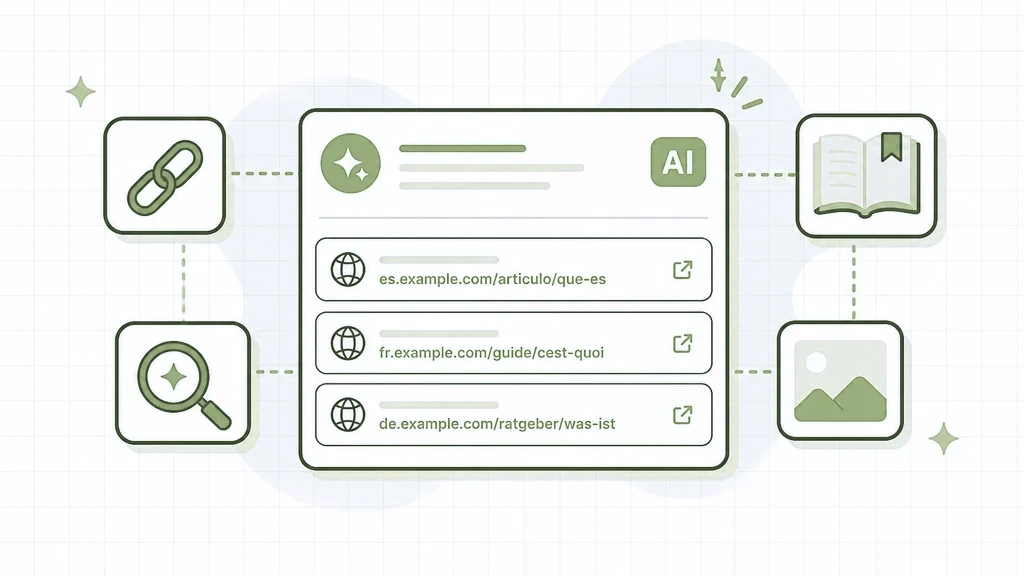
Google’s generative AI features in Search—AI Overviews and AI Mode—have shifted how teams talk about visibility. The vocabulary changed faster than the fundamentals. AI-assisted answers still draw from pages Google can crawl, index and treat as snippet-eligible. For multilingual sites, that means language-version quality, crawlable architecture and people-first content matter as much as—or more than—any “AI optimization” checklist circulating on social media.
This guide connects official Google guidance on AI search features to multilingual SEO programs: what eligibility actually requires, which myths to ignore, and how to measure without treating generative answers as a separate ranking system.
Questions this guide answers
- How do Google generative AI features relate to core SEO?
- What must a page satisfy to appear as a supporting link in AI Overviews or AI Mode?
- What is retrieval-augmented generation (grounding) in Google Search AI features?
- How should multilingual sites think about AI search differently from single-language sites?
- Which multilingual technical fundamentals still matter for AI features?
- What myths does Google explicitly say you can ignore for generative AI search?
- How should teams measure visibility in generative AI features?
- How do content quality and language-version quality affect AI search eligibility?
Quick answer: AI search still depends on SEO
Google states that its AI features in Search are rooted in core ranking systems and quality evaluations—not a parallel universe where classic SEO stops mattering. Pages that struggle to be indexed, snippet-eligible or trustworthy in ordinary Search are unlikely to become strong supporting sources in AI Overviews or AI Mode.
For multilingual teams, the practical implication is straightforward: fix language-version architecture and content quality first. There is no additional “AI tech stack” Google documents for generative features. Indexed, crawlable URLs with unique, people-first content in the correct visible language remain the baseline—whether the user sees a blue link, a snippet or a supporting citation beneath an AI-generated summary.
How AI Overviews and AI Mode work at a high level
AI Overviews and AI Mode generate responses that synthesize information from the web. When Google’s systems produce these answers, they can include supporting links—references to pages that helped ground the response. Those links come from content Google already understands through its Search index.
At a high level, the flow looks like this:
- A user submits a query (classic Search or AI Mode).
- Google’s systems may expand or refine the query internally.
- Relevant pages from the index are retrieved and evaluated.
- A generative response is produced, optionally with links to supporting sources.
Multilingual sites should not assume one English master page will “feed” every locale’s AI answer. Grounding retrieves specific URLs. If your French audience’s question is best answered by a thin French template with English body copy, that URL is a weak candidate—regardless of how strong the English original is.
Grounding, RAG and query fan-out
Google describes grounding (sometimes discussed industry-wide as retrieval-augmented generation, or RAG) as the process of connecting a generative response to real web content. The model does not invent citations from nothing; it draws on material Google has indexed, then may surface some of those pages as supporting links.
Two concepts matter for SEO teams:
| Concept | What it means in practice |
|---|---|
| Grounding / RAG | Generative answers are tied to retrieved index pages, not freestanding hallucinations |
| Query fan-out | Google may issue multiple related sub-queries internally to gather breadth before synthesizing an answer |
Query fan-out explains why a single page might appear as a supporting link even when the user’s phrasing differs from your headline. It also explains why shallow, commodity pages rarely sustain visibility: fan-out retrieves competitors and alternatives too, and quality signals still apply across the candidate set.
For multilingual properties, fan-out may run in the user’s query language. If you have not invested in complete topic coverage in that language—guides, definitions, comparisons, implementation detail—retrieval has fewer of your URLs to choose from. English-heavy programs sometimes misread that as “AI prefers English.” Often it means the English cluster is simply the only complete one in the index.
None of this replaces rankings. It reframes them. Your page must be among the material Google trusts enough to retrieve and quote in context.
Eligibility requirements (no extra AI tech stack)
Google’s documented eligibility bar for appearing as a supporting link aligns with ordinary Search visibility:
- The page must be indexed.
- The page must be eligible to appear as a snippet (not blocked from snippets in ways that remove preview eligibility).
Google does not publish a separate checklist of AI-only tags, files or markup required for AI Overviews or AI Mode. If a vendor sells “AI Overview schema” or insists on chunking every paragraph for LLMs, that is not grounded in Google’s public guidance.
What does help is the same content discipline Google recommends elsewhere:
- Unique, non-commodity information that serves people first
- Clear topical focus so retrieval systems can match queries to pages
- Avoidance of scaled, low-value pages built primarily to capture long-tail variants
Structured data can still be valuable for rich results in classic Search. Google explicitly notes it is not required for generative AI features—but that is not an argument against schema where it genuinely describes your content.
Why multilingual programs feel different
Single-language sites worry about one indexable URL per topic. Multilingual sites worry about N URLs per topic—each needing to stand on its own for retrieval.
Generative features amplify differences multilingual teams already know:
| Single-language habit | Multilingual reality |
|---|---|
| One canonical article per topic | Each language version competes for retrieval in its language context |
| Translation managed as a post-publish step | Late translations produce lagging or thin alternates |
| SEO reviews one URL | SEO must review clusters—hreflang, switchers, completeness |
Google determines page language from visible content, not from URL folders, lang attributes or hreflang alone. A /de/ path with English body text is still an English page to Google—and a poor candidate to ground a German AI answer.
Multilingual programs also face boilerplate-only translation: navigation and footer localized, main content untouched. Google warns this creates a bad experience when the same core content repeats with different chrome. In AI-assisted results, that pattern signals an incomplete language version, not a trusted local source.
Multilingual technical fundamentals that still matter
Google’s multilingual and multi-regional guidance remains fully relevant for AI features because grounding pulls from the same index.
Different URLs per language version. Do not rely on cookies or browser settings to swap language on one URL. Crawlers may not see every variation.
Language from visible content. Ensure body copy, headings and navigation match the intended language.
Hreflang and sitemaps. Use hreflang (HTML, HTTP headers or XML sitemap) to map alternates.reciprocally. Sitemaps help discovery of every language URL you want indexed.
User-facing language choosers. Link between versions explicitly. Avoid automatic redirects based on guessed language or location—users and crawlers should reach alternates reliably.
Complete language versions. Ship fewer locales with full content rather than many locales with template-only translation.
These fundamentals do not guarantee placement in an AI Overview—Google does not offer that contract—but they are prerequisites for any language version to participate in retrieval at all.
Content quality for AI features across languages
Google’s helpful, people-first content guidance applies to AI eligibility in every language. Generative systems prioritize material that is original, substantial and created for users—not for search engines alone.
Practical quality bar for multilingual teams:
- Translate or localize the main content, not only chrome. Metadata, headings and body must read naturally in the target language.
- Avoid commodity scaling—the same FAQ with city name swaps, or thousands of near-identical programmatic pages—across locales.
- Keep important information in textual form. Images and video can expand appearance opportunities, but core facts should be readable as text so retrieval and previews work.
- Demonstrate experience and trust in each market’s language: accurate claims, sensible examples, appropriate legal and commercial details.
Machine translation without editorial review often produces fluent but generic copy—exactly the kind of content Google classifies as low value. Localization quality is not a separate “AI step”; it is part of whether a language version deserves to be retrieved.
E-E-A-T framing is useful as shorthand for people-first quality, but it is not a checklist of badges. Focus on whether a native speaker would recommend the page—not whether it mentions AI keywords.
Myths to ignore
Google’s AI search documentation explicitly debunks several industry practices. Multilingual teams should treat these as distractions:
| Myth | What Google says |
|---|---|
Special AI files (e.g. llms.txt) are required | Not part of documented eligibility for Google Search AI features |
| Chunking pages purely for AI consumption | Unsupported hack; prioritize clear human-readable structure |
| Rewriting content solely to target AI Overviews | Write for people; do not chase generative formats as a tactic |
| Inauthentic entity or mention stuffing | Misleading signals harm trust; not a documented best practice |
| Structured data is mandatory for generative AI | Not required—though still useful for eligible rich results |
Also ignore vendor narratives that imply AI Overviews use a secret parallel index. They do not. They use the Search index you already feed through crawlability, quality and snippet eligibility.
Measurement in Search Console
Google Search Console now reflects generative AI features in performance reporting. Teams should use it to understand trends—not as a guarantee of future citations.
Web traffic and AI features. Search Console categorises traffic associated with AI experiences alongside familiar web metrics. Use it to see whether URLs gain impressions or clicks from AI-assisted surfaces.
Generative AI performance report. Where available in your property, review which queries and pages interact with generative features. Compare language versions: if French URLs never appear but English URLs do for related topics, that is a content or architecture signal, not an “AI settings” knob.
Measurement tips for multilingual properties:
- Segment by language URL patterns or subdirectories where possible
- Track supporting-link appearance as a secondary KPI to classic clicks and conversions
- Investigate sudden drops alongside snippet blocks, index coverage and major template changes
- Compare AI-feature impressions before and after a locale quality sprint—not only after technical deploys
Avoid setting OKRs like “100 AI Overview citations by Q3.” Google does not offer deterministic control. Treat generative visibility as an outcome of foundational SEO and content quality.
Controls: robots, snippets and Google-Extended
Teams sometimes conflate three different control layers. Keep them separate.
robots.txt and Googlebot. Use robots rules to manage crawling by Googlebot. Blocking crawl removes pages from the index over time—so they cannot ground answers.
Snippet controls (nosnippet, max-snippet, noindex). These affect preview and snippet eligibility, which Google ties to supporting-link eligibility. A nosnippet directive can remove a page from consideration for previews—including generative citations.
Google-Extended. Google offers a separate control for use of content by some other Google AI systems outside the classic Search crawl/snippet context. It is not the same switch as AI Overviews eligibility in Search. Read the current Google documentation before changing robots tokens; policies evolve.
Multilingual sites should apply controls consistently per URL. Blocking snippets on /fr/ but not /en/ sends mixed signals across a hreflang cluster.
Multilingual AI-search checklist
Where GlotEO fits
Multilingual AI search readiness is mostly disciplined language-version SEO—not a separate product category. Teams stall when alternates multiply faster than editorial quality keeps up. GlotEO’s multilingual AEO platform supports multilingual content workflows so language versions stay coherent, reviewable and aligned with search fundamentals—without promising AI Overview placement.
If you are planning locale expansion, treat AI features as a reason to tighten architecture and content quality, not to buy unverified “GEO” tactics. Foundations still start with GlotEO’s multilingual SEO platform.
Explore GlotEO’s multilingual AEO capabilities or compare multilingual website pricing.
Companion work on international site architecture is already drafted for the library. Dedicated coverage of how third-party AI systems discover websites remains on the roadmap as a planned article.